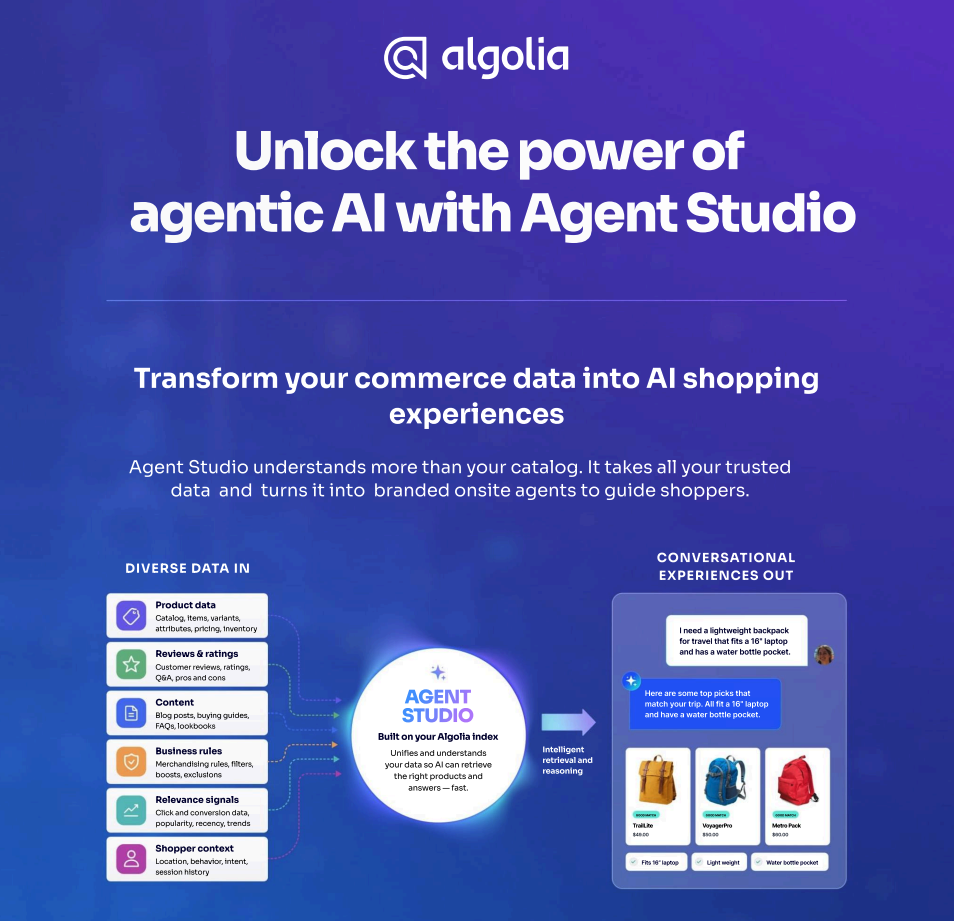
For conversational applications, you’re likely connecting to the LLM’s interface directly from the frontend. We recommend Agent Studio here at Algolia, since it lets customers give LLMs access to structured search indexes where it can find factual information about products, past content, etc. This makes the agent less of a writer and more of a translator, just taking those facts and putting them in the right context and voice to drive revenue and positive user experience.
But do all LLM applications directly involve user interaction? No! There are so many ways agents could be used in background or utility tasks, triggered by our webapp’s backend. In this article, we’ll explore a few ideas to show you the tip of the iceberg of how agentic workflows can improve your ecommerce business.
Cross-category reasoning
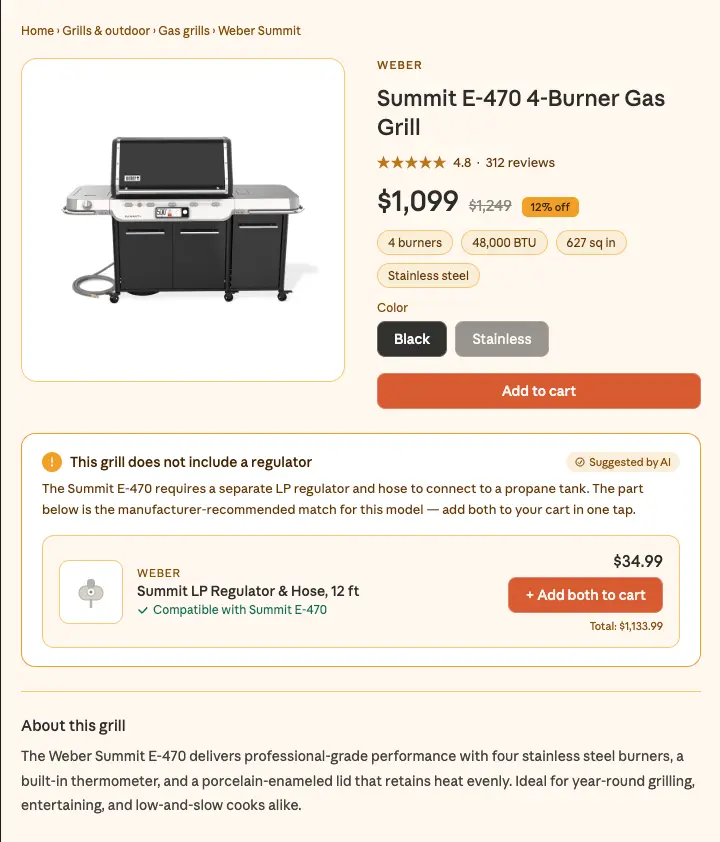
Our recommendations models can suggest items that are often bought together or that are semantically similar, and many times that’s what you need to boost revenue. But sometimes, you’re selling products that are only technically compatible with specific other products in the index, like a grill and its matching propane regulator. In those cases, you’ll build even more trust with your users by suggesting the perfectly compatible items.
Solution: Trigger a backend agent on every new addition to your index which searches that index and creates a new related_products attribute, an array of objectIDs of other products in our catalog that are precisely compatible with this one. Then we store the related_products attribute on the record, and also update each of those related product records to include the current objectID in their related_products array as well.
A product page for a grill highlights what matching regulator to buy with it, thanks to an agent made with Algolia Agent Studio extracting the match from the product description and generating the copy.
Consistent product descriptions in your brand voice
Manually maintaining a unified voice across thousands of SKUs from multiple vendors is a massive operational bottleneck. When you ingest raw data from various third-party sources, your product pages often end up with mismatched tones, inconsistent lengths, and varying levels of quality. This lack of cohesion confuses your customers and weakens your brand's authority, but unfortunately trying to manually rewrite every single entry is an impossible scaling problem.
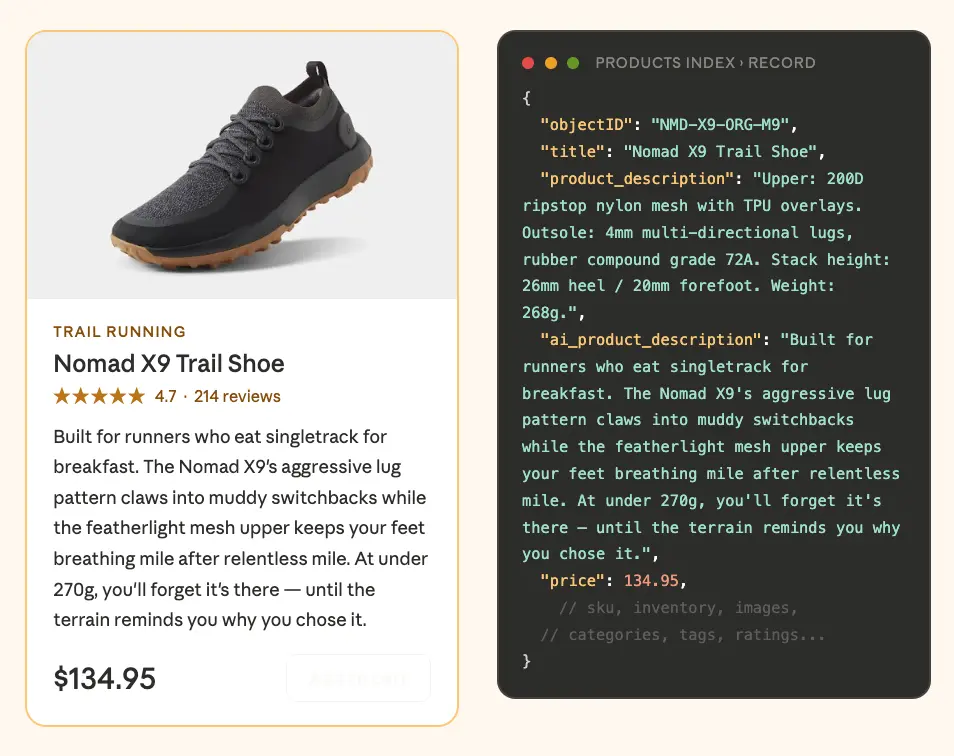
Solution: Trigger a headless agent from your backend every time new data is ingested. In the prompt, instruct it to search for high-performing products in the same category, learn the brand voice from the copy in those records, then add a new ai_product_description attribute containing this new product’s description using that same voice. Then in your UI, you’ll always display this standardized agentically generated description, but you’ll still have the original in the record itself.
A product card for a running shoe after an agent made with Algolia Agent Studio uses data from other attributes to create an approachable, accurate product description matching the brand’s voice.
Contextual SEO and ad content
Marketing teams often struggle to keep ad copy and SEO metadata aligned with a constantly shifting inventory. When you’re running campaigns for hundreds of "Trending" or "High-Margin" items, static ad templates quickly become generic, failing to highlight the specific technical differentiators that actually drive conversions. This disconnect between what’s in your index and what’s in your ad spend leads to wasted budget on vague messaging that doesn't reflect the real-time value of your products.
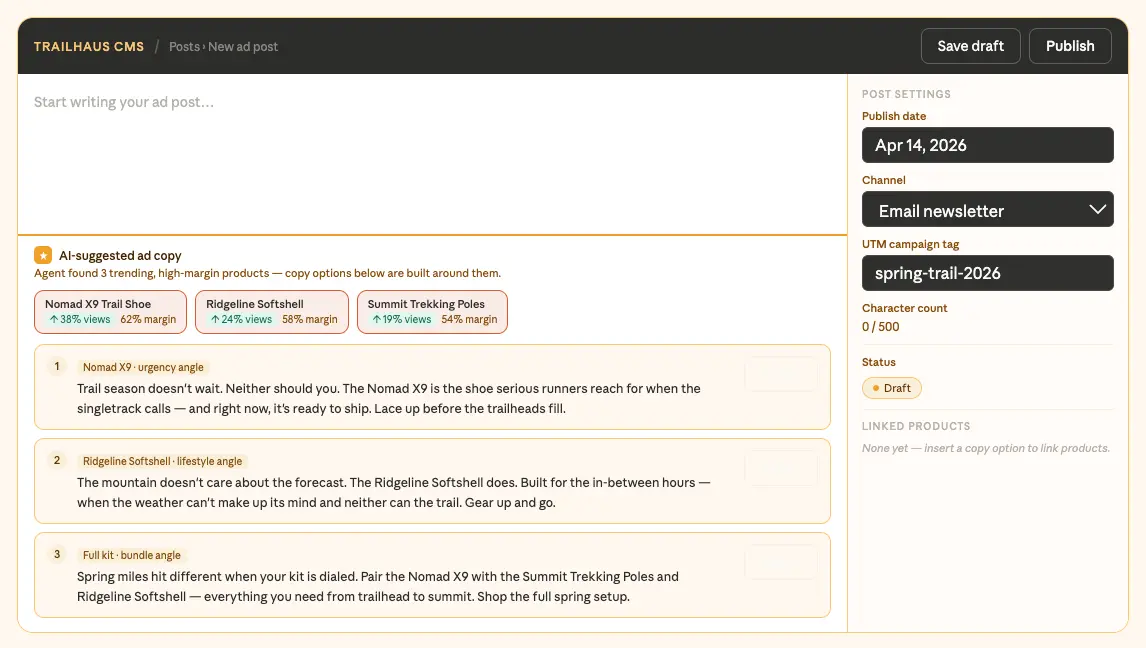
Solution:Give an agent a tool that retrieves the products labelled as trending or high-margin in your CMS or your analytics software. Since that tool would be built with Agent Studio, it can look up those products in your Algolia index, compile their selling points, and write you copy options for SEO articles, Google Ads, email blasts, or whatever other format you ask it to. This agent could be triggered directly by copywriters and marketers as they write content in your CMS, and the potential options produced can be presented to those team members with a simple, integrated edit-and-approve UI for maximum efficiency.
An example of a custom CMS plugin developed using Algolia Agent Studio, which grounds ad copy suggestions in real product data.
Dynamic sales team enablement
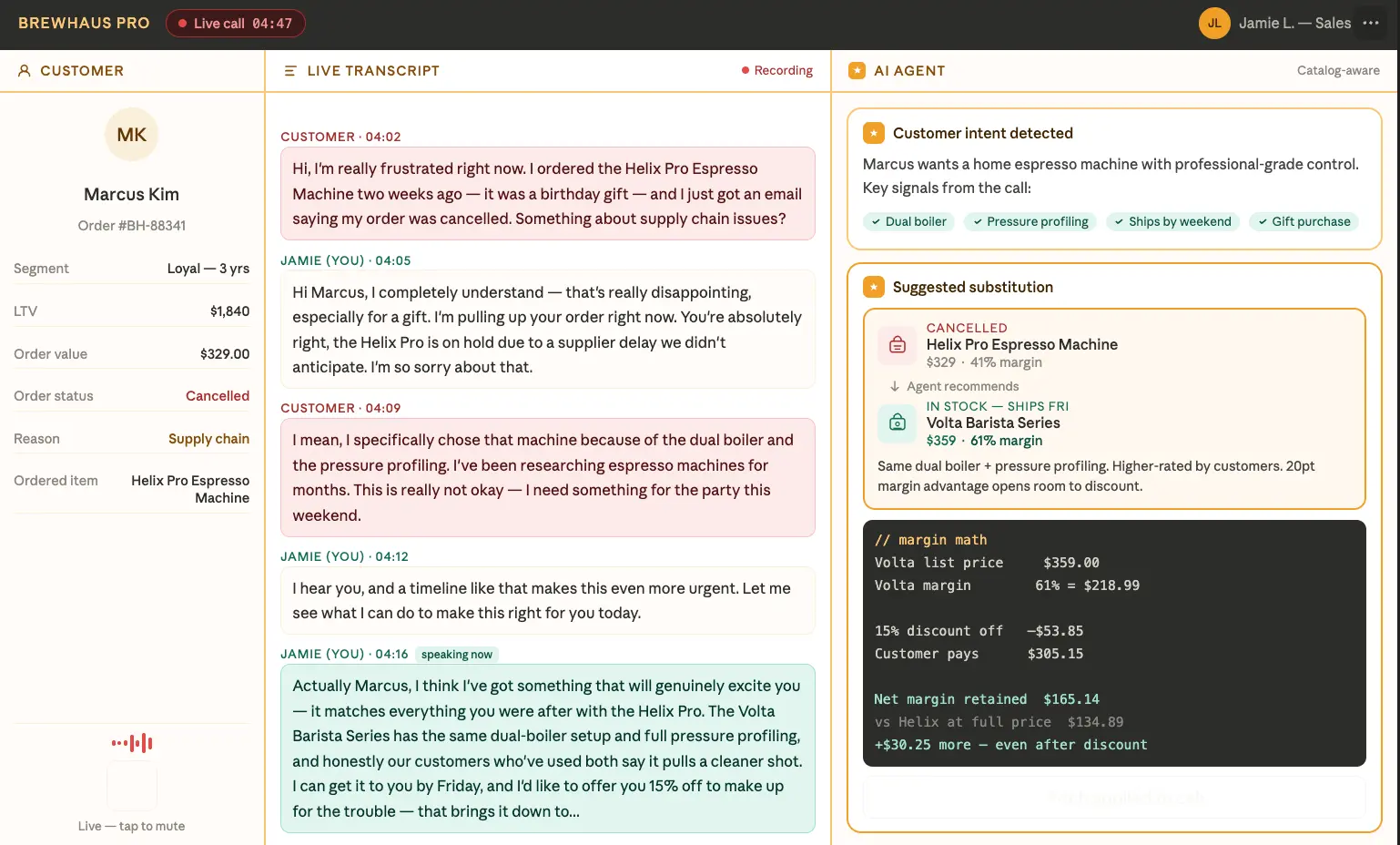
Sales team members often struggle to provide immediate alternatives when a customer’s first choice is out of stock, has a shipping issue, or otherwise isn’t available. Without a deep, real-time understanding of the entire inventory, the opportunity fizzles because the representative can't quickly identify which other products match the buyer’s intent. Missed sales and overwhelmed reps lead to low revenue and high staff turnover.
Solution: Build an agent not just to chat with, but to take in a real-time transcript of a sales conversation and display its output as actionable, proactive advice alongside the rep’s conversation window. Prompt the AI agent to grasp the user’s intent, search the index automatically for alternative products that fit, and notify the human sales rep in real-time so they’re never underinformed. A similar AI agent could be used in a regular cronjob to identify the products that will have these issues before any sales ever get disrupted, pinging the team in Slack so they’re equipped to offer data-backed recommendations immediately without needing to become experts on every single SKU in the inventory.
An example of a dashboard for a human customer service agent named Jamie. They’re receiving a call from an upset customer whose order is delayed, and a live transcript is being printed out as they’re conversing. An AI agent built with Algolia Agent Studio is parsing the live transcript and the product catalog to proactively recommend solutions that Jamie can offer to the customer.
The agent as a specialized knowledge layer
The through-line across all four of these patterns is the same idea: your Algolia index already contains the knowledge your business needs to act smarter. It knows the compatible parts, brand voice signals, margin data, real-time inventory, etc. But that knowledge has always been inert until a human went looking for it, and agents change that. They turn your index from a database you query into a specialized knowledge layer that runs in the background, whenever you need it to. It’ll enrich records, brief your team, and generally inform all your business operations.
This architecture is the key to making it all work smoothly: a backend that knows when to trigger an agent, an agent that knows how to search your index, and a UI that surfaces the output exactly where a human needs to act on it. Agent Studio handles the middle piece natively (the search abstraction, the RAG, the API key wiring) so your backend layer stays thin and flexible.
Start with one pattern. The regulator problem, or the brand voice inconsistency — whichever one you'd normally solve with a spreadsheet and a contractor. Build the trigger, define the tool, write the prompt. Once the first agent is in production, the second one is just a different prompt.
Here’s the takeaway: Your index is already the smartest thing in your stack, so why not give it a voice?
Sign up today to try Agent Studio, and check out our docs on what you can build today.











.webp)


.jpg)



%20(2).svg)
