Agentic AI
AI is transforming the workplace in ways both highly publicized and invisible. The change is happening fast. Gartner believes a third of all businesses will have agentic AI embedded in their digital infrastructure by 2028, up from less than 1% today.
With the rapid development of AI functionalities, forward-thinking organizations are reimagining how to integrate engagement into their digital infrastructure. Many routines and system requests will now happen in the backend, without specific human interactions. Those hidden routines, however, will still impact the customer experience and thus must deliver seamless, personalized service.
Wide integration of agentic AI will change not only how specific jobs are completed but also how workflows function in general. With minimal human inputs, machine learning (ML) agents will coordinate simultaneous subtasks, interacting with an organization’s tech stack to deliver required business outputs.
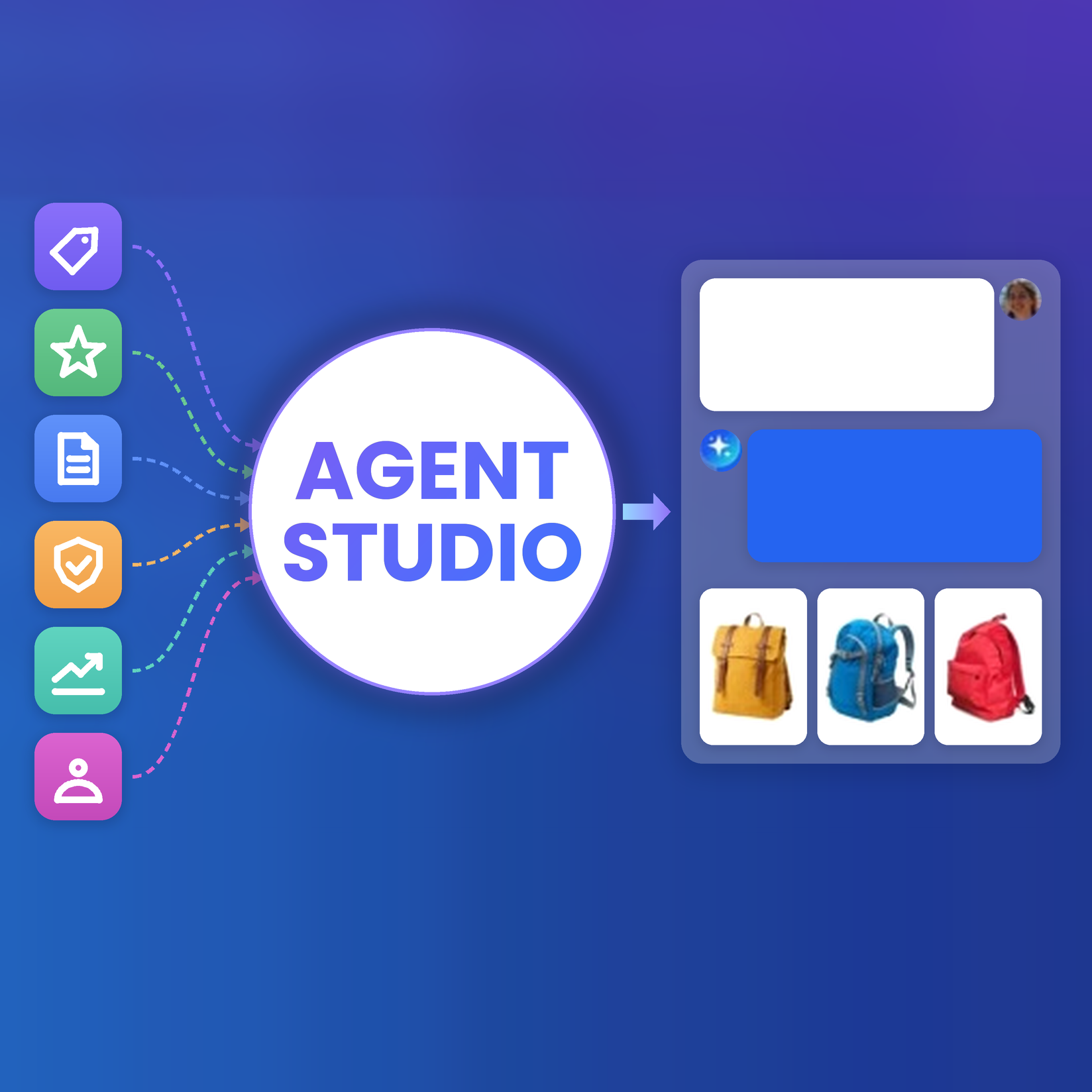
Getting those agents right is the necessary first step. Algolia’s Agent Studio gives you the ability to create, test, and launch AI agents on a business-sensitive timeline.
What AI agents are and what they do
An AI agent is a logic engine that interprets inputs then uses tools to execute actions to return appropriate outcomes. The advanced automation of agentic AI coordinates multiple tasks across systems to achieve complex goals with minimal human input.
Capable of autonomously performing complex, multi-step tasks, AI agents aren’t limited to any specific function. Instead, they can be purposed to accomplish a wide range of activities, depending on need. For particularly complicated tasks, agents can be networked together into multi-agent-systems (MAS).
AI agents can be – and are being – deployed across sectors from retail to manufacturing to finance. Autonomous and proactive, specialized AI agents are integrated into and function in system backgrounds, adapting their processes as needed to improve outcomes. Control, flexibility, and transparency are the hallmarks of effective AI agents. Agent Studio provides market-ready agentic services, so you can build, test, and deploy AI agents in days, rather than months.
Tools and technical information

Algolia has long been an industry leader in search and retrieval. With Retrieval Augmented Generation (RAG) capability and a Model Context Protocol (MCP) server, we also have the capacity to provide a context layer for AI agents. Designed for developers, Agent Studio coordinates your input, Algolia’s indices and tools, and the LLM of your choice to create AI-powered workflows.
- Retrieval Augmented Generation (RAG): RAG combines semantic retrieval with Large Language models (LLMs) so organizations can give conversational responses using their own datasets, retrieving the most relevant responses while simultaneously applying business rules to deliver context-aware answers to natural-language queries
- Model Context Protocol (MCP): MCP connects natural language agents and structured indices, defining a universal format to translate requests between LLMs and other programs into precise APIs, so developers can skip the step of writing custom API layers
RAG integrates your business priorities into retrieval ranking, while MCP ensures factual accuracy. Good data combined with clean operational structure and standard protocols ensure your AI agents fulfill their functions.
How does Agent Studio work?
A secure, intuitive framework built on our AI-powered infrastructure, Agent Studio integrates LLMs with behavioral data, configurable logic, and real-time search so you can easily build secure, responsive, generative AI experiences using your Algolia data.
In Agent Studio’s sandbox environment, you can create your AI agent, configure it with defined prompts and tools, and test its functionality both before and after adding your API key. Once you publish your agent, you can integrate it into your app with our API or AI SDK UI.

With composable building blocks, you can configure flexible workflows, define prompts, and establish permissions. Keyword, vector, and business rules combine together in a single, powerfully relevant system. Derived from 1.75 trillion searches annually, Algolia’s recommendation engines and customer data analytics are powerful tools available to you, or you can bring your own tools and the LLMs you need most.
- Whether you use a template or start from scratch, the steps are simple and friction-free:
- Define the role you want your agent to play, including preferred style and any constraints
- Add the tools and indices you need (your own or Algolia’s)
- Choose a model (no vendor lock in)
- Publish your agent and integrate with a dashboard and API
The benefits
Algolia’s Agent Studio saves development time and resources, adding bandwidth better spent on wider strategic goals. Since your data includes past sales and browsing history, follow-up prompts can be personalized and targeted. An AI agent can lessen administrative load, reduce guesswork, and distill the answers you need quickly, resulting in these benefits:
- Speed: Go from first idea to production in days, rather than weeks or months. Deploy your agents when and where they’re most useful
- Control: Using your own data, logic, and LLM reduces retrieval of errors and outdated information and ensures omnichannel consistency
- Adaptability: Test and tweak iterations of your agent quickly and safely in Agent Studio’s secure sandbox environment
- Security: Scale your agent safely with defined and testable permissions. Avoid shadow data and keep your brand’s reputation intact
- Simplify: The process is simple, and the Algolia platform handles AI orchestration, engineering, and setup for you
- Flexibility: With transparent pricing and no vendor lock in, you can use your own LLM, helping you manage both your infrastructure and your costs
RAG enhances your architecture to optimize user query, context, and LLM data to generate the most efficient and factually grounded results. The result is reduced handling time and increased conversion. Conversational and image-based search improve the customer experience by helping them find what they need faster.
Real-world examples
Agentic AI has a wide range of use cases. Some are customer facing, driving conversions, engagement, and sales. Others streamline internal processes and workflows. Here are some of the most successful examples.
Shopping assistants

For a customer in need of help, a shopping assistant is an invaluable resource. With Agent Studio, you can build conversational agents that answer queries in natural language, so your customers can shop the way they think. Built on past patterns and purchases, agents can use current micro-interactions to capture intent as it may evolve. Deliver capable flexible assistants in fields such as:
- Fashion: A fashion advisor who delivers not only tailored recommendations but shifts contexts in near real time when interest shifts
- Grocery: An aid to suggest meals, identify items in uploaded files, and create shopping lists that take on-hand availability into account
- Media: A guide to discover the next eBook, movie, podcast, or show
- Travel: Help vacationers decide what type of holiday they want most in addition to making the appropriate flight and hotel bookings
Product questions and answers

AI agents can generate content from verified and accurate internal datasets as needed:
- Enterprise: Make internal knowledge immediately available and accessible by answering conversational questions like, “What safety rules have changed?” or “Does this article adhere to new brand guidelines?”
- Fitness: Using exercise data collected from smart devices, a trainer agent can advise on equipment and exercises needed to meet desired fitness goals
- Medicine: AI monitoring produces alerts, both in and out of hospital, and can generate notes during intake procedures
- SaaS: Businesses can produce in-product guidance at will, create pilots for the onboarding process, or troubleshoot workflow friction
Customized operations and workflows:

Every organization has internal documents and datasets full of company-specific information. Agents can provide instant access to that factual company information with complete control and traceability.
- Content summarizer: Extracting key information from large datasets can be labor intensive and time-consuming. Practiced LLMs, trained on controlled data, can surface the most crucial information for summary purposes, flag changes to internal documents, and free bandwidth for thought leadership and decision-making
- Customer service: Reduce customer wait times for routine policy or process questions, improving customer satisfaction, freeing CSRs to handle more complicated or sensitive situations, and reducing both escalation and budget
- Performance insights: Analyze performance across channels, from evaluating the success of marketing campaigns to examining weekly sales highs, to monitoring compliance training
“There are three types of customer experience critical for every online retailer: search & browse, grounded generative experiences; and agentic AI experiences. Algolia is here to meet customers on the journey, where they are.”
- Bernadette Nixon,
Algolia CEO & board member
Conclusion
Building on our unparalleled excellence in search and retrieval, Algolia’s Agent Studio allows you to rapidly build, test, and deploy branded conversational AI agents, whether those agents are used to improve the customer experience, eliminate workflow friction, or boost business outcomes.
Straightforward to use, Agent Studio is a fast and secure way to build retrieval-powered AI agents. Sandbox testability allows you to refine and scale up quickly, making seasonal rushes smooth and seamless.
Highlight your brand with responses pulled from your own up-to-the-minute data. Your AI agents can help your customers find what they want based on meaning rather than token matching, shorten routing workflows to broaden capacity, and ensure search results are grounded in accuracy.