Everyone wants to feel like a VIP.
Successful brick-and-mortar retail businesses make an effort to provide personalized customer service. They learn their customers’ names. They know their favorite brands and preferences. The best associates are keen observers. They see what customers pay attention to and what they pick up. They remember what they ask about and what they linger on. Knowing their product line backward and forward, they make on-the-spot recommendations that build relationships and boost conversions.
Those personalization efforts make a substantial difference to customer engagement, customer loyalty, conversation rates, and order volumes.
AI personalization lets ecommerce sites deliver a similar personalized experience across online touchpoints. It’s the strongest tool in your search arsenal for keeping site visitors satisfied, engaged, and returning.
This eBook is a primer on AI-enabled personalization for ecommerce. We explain what AI personalization is, how and where to use it, and why it’s a worthwhile investment. AI is a remarkable tool that is most effective in accelerating and automating sales when fine-tuned by your own team who know your business best. To that end, we’ve outlined what you need to consider when developing an AI personalization strategy that reinforces your connection to your customers and meets your high-profitability goals.
What is ecommerce personalization?
Ecommerce personalization is the process of tailoring the customer journey to an individual visitor’s needs and preferences.
When a customer arrives at an ecommerce site to search for an item or browse products and services, each interaction is customized to that specific individual. Search results reflect their interests or search history. Page attributes are shuffled to match their preferences or shopping habits. Instead of running a one-size-fits-all promotion, each product recommendation and cross-sell is tailored for that customer.
You’re probably familiar with these personalization efforts:
- Add a {first name} to a page or an email to acknowledge your customer or welcome them back
- Add a “recently viewed” image carousel on a product page to assist your customer’s discovery process
- Re-order the list of product categories so your customer’s favorites are at the top
While ecommerce personalization is defined by how it shapes the customer journey, it’s also an important business strategy that supports revenue growth. In other words, the personal touch pays.
McKinsey research shows that websites investing in personalization earn 40% more revenue than those that don’t. No longer a site “extra,” online shoppers have come to expect personalized interactions. That personalized greeting on a favorite website, those “just for you” product suggestions, that pop-up reminder to select products with free shipping, and so on — the sum of these personalized touches have become the pathway to ecommerce success.
How does AI-enabled personalization work?
To understand how personalized experiences are crafted, we need to lift the hood on personalization tools. Here’s how it works:
- A data source layer gathers and processes data events and data records, (i.e., the actions — views, clicks, and purchases — a customer carries out across digital touchpoints and the specific catalog items your customer engaged with).
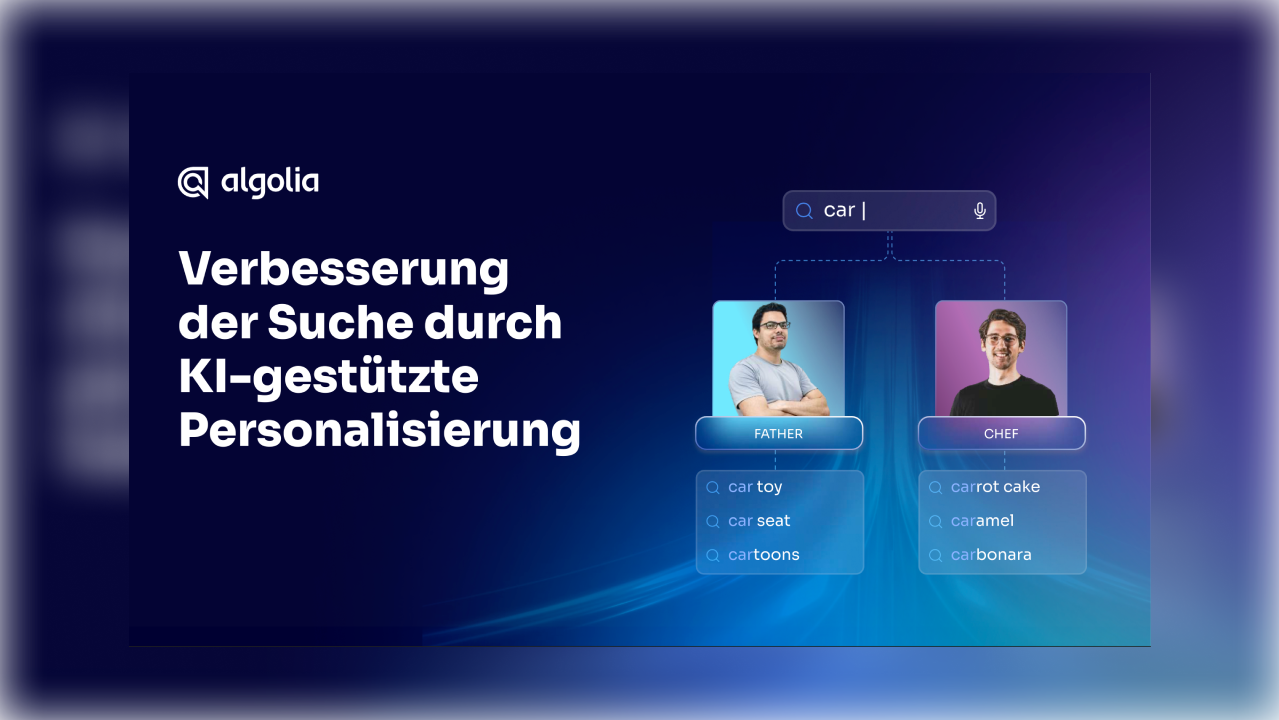
- AI and machine learning (ML) algorithms weigh and measure these data events and data records. They’re scored across 100+ attributes, such as brand, category, price, and more. The scores are then used to build a sophisticated user profile that’s optimized to support ongoing customer engagement and drive business objectives.
- When customers enter queries into the search toolbar or browse the site or app, their user profile and attribute scores are applied to results rankings. When customers see personalized results that anticipate their preferences and reflect their needs they are more likely to convert.
The approach isn’t only applicable to ecommerce search. User profiles and attributes can also be used to personalize autocomplete for any type of online discovery, making search faster, smoother and more intuitive by anticipating what site visitors are looking for from the very first keystroke.
Browsing and discovery have personalization potential as well:
- Personalized facet re-ordering re-shuffles facet lists to reflect the attributes your customer cares about most. When Adidas is someone’s favorite shoe brand, ordering facets from A to Z might appear to be useful. But if their favorite shoes are by Zadig & Voltaire, scrolling down to “Z” can be frustrating and feel impersonal.
- Personalized product recommendations leverage user profiles to make relevant product suggestions. Showing customers undiscovered items with attributes they prefer encourages deeper exploration of the site — and more sales.
- Promotions by segment use user profiles to create rules and promote products to customer groupings, such as “new/returning,” “mobile/desktop,” and “loyal/inactive” to support business goals.
Data: the fuel of AI personalization
Marketers rely on detailed demographic and geographic information to target content to customer segments. Ecommerce personalization works similarly, but the sophistication of AI can derive far deeper insights from more granular information.
Segments are useful, but can be hit-and-miss.
Consider a physically active, 75-year-old grandmother who’s on the hunt for athletic socks and running shoes. If a sales strategy focuses on age group exclusively, she may be shown diabetic compression socks and orthotics instead of the snazzy kicks she bought last time.
AI-enabled personalization tracks shopping behavior and assigns your customers into segments based on common demographics, geographic locations, attitudes, behaviors, and other attributes, rather than classifying them into overly generalized groups. User profiles give you a finely tuned picture of each customer’s interests, preferences, and needs. They level up your marketing game so you never risk losing an order or alienating a long-standing customer.
Zero-party and first-party data
Ecommerce sites need data to start personalization. To uphold data privacy regulations, that data needs to be provided voluntarily. Zero-party data is information shoppers are explicitly asked to supply via:
- Polls, questionnaires, or quizzes
- Through customer feedback forms or reviews
- From thumbs up/thumbs down buttons on products
A bookstore site can poll site visitors about literary genres to learn what categories the customer prefers. This data can be leveraged to reinforce or deprioritize items and make relevant title suggestions. Zero-party data is free, reliable, and transparently gathered, which is reassuring for everyone.
86% of American consumers are concerned about how companies use their personal data.
First-party data is derived from interactions on digital touchpoints. When a customer “opts in” to cookies on an ecommerce site or app, they consent to monitoring to support personalization and for better site performance. This data comprises:
- Search terms and queries
- Clicks on products and categories
- Browsing activity and navigation pathways
- Amount of time spent on different pages or items
- Shopping cart contents (including abandoned carts)
- Conversions and order values
- Items in a wish-list
Personalization software observes where customers go, tracks their browsing activity, records their search terms, and knows their purchase history. Fed into an AI-enabled personalization platform, this data can be analyzed to craft highly satisfying — and profitable — shopping experiences.
Balance your need for data with data privacy protection
A 2023 KPMG survey revealed that 86% of American consumers are concerned about how companies use their personal data. Forty percent don’t trust companies to use their information ethically. To keep customer trust:
- Be forthcoming about what data you collect from the first moment of contact
- Give customers a way to opt out so everyone’s data privacy needs are respected
Payoffs: What makes AI-enabled personalization so powerful?
When a site or app “knows you,” it’s meaningful and memorable. If an ecommerce grocery store leverages your purchase history to suggest a new “limited edition” flavor from your go-to potato chip brand, an upsell opportunity becomes a special invitation. It feels like first dibs on an exclusive product drop.
Personalization’s predictive power forges a deep and lasting customer connection. The uplift in customer engagement and loyalty encourages purchasing, brings customers back, drives progress on critical KPIs, and justifies ROI. In fact, research shows that companies using advanced personalization are seeing a $20 return for every dollar spent.
Ecommerce retailers use AI-enabled personalization to:
- Drive conversions: When shoppers find a list of items “based on items you viewed recently,” they stop and look. Personalizing the journey entices shoppers to purchase products that complement what they bought last time
- Encourage deeper discovery: Newer customers need help discovering your catalog. Personalized suggestions encourage them to dig deeper.
- Simplify site exploration: By curating relevant items, you save your customer time and make their experience smoother, more efficient, and more satisfying
- Enhance customer retention: Making customers feel special by delivering a customized experience encourages repeat visits, increases conversions, and drives up order values.
- Eliminate null results: Leveraging user profiles helps identify relevant items in your catalog in place of null results, providing a valuable jumping off point
- Boost order size: Shoppers put more trust in personalized suggestions, resulting in more conversions from “just for you” items and promotions.
People want to be recognized for who they are and remembered for what makes them unique. In one survey, 45% of respondents said they’d leave a site due to a lack of personalization. To keep users engaged, deliver a seamless, VIP experience that meets their needs and respects their time. Ecommerce retailers that harness AI-enabled tools to deliver a personalized experience will reap the rewards.
The challenges of implementing AI-enabled personalization
The “AI” aspect of AI-enabled personalization is incredibly powerful, but it’s not magic. Marketing and developer teams that use AI-powered tools successfully know there’s an art to the science of machine learning.
AI-enabled personalization is a hybrid approach that relies on both technology and people, combining your organization’s technology tools with expertise and merchandising savvy. Applying it effectively to maximize customer lifetime value (CLV) requires continuous fine-tuning and optimization.
The hybrid approach to AI-enabled personalization
- Technology: advanced AI/ML infrastructure and capabilities
- People: developer and merchandiser teams who can leverage data-driven techniques to build outstanding customer experiences that achieve your business objectives
In other words, you can’t set it and forget it. To ensure ROI from a business perspective, you need to harmonize your infrastructure and capabilities, data sources, and personalization approach across search, browse, and discovery.
Other challenges with AI-enabled personalization include:
- Keeping data current: People’s preferences and behaviors evolve as they age and trends change. Since outdated data can have a negative impact on personalization, you need to keep datasets and user profiles current.
- Availability demands: ML-aided algorithms analyze large datasets. Any platform that you use needs sufficient computing power and availability required to fine-tune and present relevant suggestions in near-real-time.
- Implementation: To support the user experience, AI-enabled personalization needs to be seamlessly integrated with other systems and platforms: ecommerce platform, customer relationship management (CRM), and content management (CMS) systems.
- Scalability: As your ecommerce site grows, data increases in size and complexity. To maintain personalized experiences across those bigger datasets, you’ll need to break down data silos and leverage ML tools effectively.
Is AI-enabled personalization right for you?
Before deciding to implement AI-enabled personalization, consider these questions:
- Practicality: Does your target audience expect it or need it?
- The market: Are your competitors using it?
- Investment: Will it change your metrics substantively?
- Data: Can you have – or can you acquire – sufficient data to support it?
- Expertise: Do you have team members to oversee technical demands and personalization campaigns?
The best scenario for AI-enabled personalization
Personalization might not be suitable for every scenario. Ecommerce businesses that benefit most from AI-enabled personalization have large catalogs and offer products to shoppers across demographics with varied and distinct preferences. If your audience or product range is extremely narrow, personalization might not make a huge difference to your bottom line.
For most retailers, however, it’s worth exploring. Customers are leaving sites that don’t personalize, but businesses that use it well are seeing substantial ROI.
One option to start with is to use personalization in a limited way to maximize one part of the search, browse, or discovery experience. For instance, personalize search result rankings or the checkout process, with upsell and cross-sell suggestions.
In fact, starting small is a great way to see whether AI-enabled personalization is right for you. Choose a single KPI (order value, active carts, conversion rate) and measure its improvement. If that’s a success, you can scale up your efforts to other KPIs.
Customers are leaving sites that don’t personalize, but businesses that use it well are seeing substantial ROI.
Start personalizing with Algolia
If you’ve decided that AI-enabled personalization is right for you, the next big question is: Should you develop it from scratch?
Building search and personalization-related functionality is time-consuming and ever-evolving. Our Ecommerce Site Search Trends 2023 report showed that more than half of companies surveyed couldn’t keep up with building their solution in-house. Our 2024 report showed 61% of respondents are increasing their investment in search to enable customers to find what they’re looking for more quickly. Partnering with a SaaS platform like Algolia that offers combined search and personalization capabilities can be a simpler and more cost effective route.
The power of AI – under your control
Algolia AI Personalization blends the best of AI with full merchandising control. Your teams can optimize personalization for search, browse, and discovery from easy-to-use dashboards in the Merchandising Studio or the API. Get started quickly by leveraging user profile data and calculating attributes automatically, then follow up with manual refinements and optimizations based on what you’ve learned. Algolia’s all-in-one solution with pre-built integrations helps you connect easily with different data sources, yielding the 360° view you need to maximize your site’s personalization potential:
- Track clicks and conversions out-of-the-box for processing with Algolia’s powerful analytics and AI tools:
- Generate user propensity scores, simulate results and compare personalization tactics with A/B testing
- Easily “drop” AI Recommendations onto your page. Suggest “Frequently Bought Together” or “Related” products from Algolia’s smart recommendation engine
- Surface products with easily configurable and flexible layout
- Enhance personalization efforts with Algolia’s AI-powered searchandising capabilities: dynamic re-ranking, query categorization, and suggested synonyms
- Optimize your indexing and curate dynamically with lightning fast, near-real-time results
With enhanced performance and industry-leading search and discovery capability, Algolia AI Personalization has the comprehensive set of tools and features merchandisers need to make informed decisions to enhance the customer experience and grow revenue.
AI-enabled personalization from the leader in ecommerce search
With customers craving the personal touch, it’s time to harness the power of personalization. Embark on your AI-enabled personalization journey with the world leader in AI Search. Algolia processes 1.7 trillion searches per year for 17,000+ organizations across the globe. Our high-availability platform delivers responses to search queries in less than 20 milliseconds. For near-real-time product search and discovery, Algolia is the best choice. With speed and capability, Algolia AI Personalization is able to provide lightning fast, up-to-date results that satisfy customers and grow your revenue.
Our end-to-end AI Personalization platform provides merchandiser and developer teams the comprehensive tools, APIs, and dashboards they need to build exceptional customized experiences. With more clicks and conversions, top ecommerce sites improved profitability:
Ready to start moving the dial on your critical KPIs?
Start your AI-enabled personalization journey with Algolia.
Algolia.com