Today, Algolia announced the acquisition of Velou, a New York-based product intelligence company.
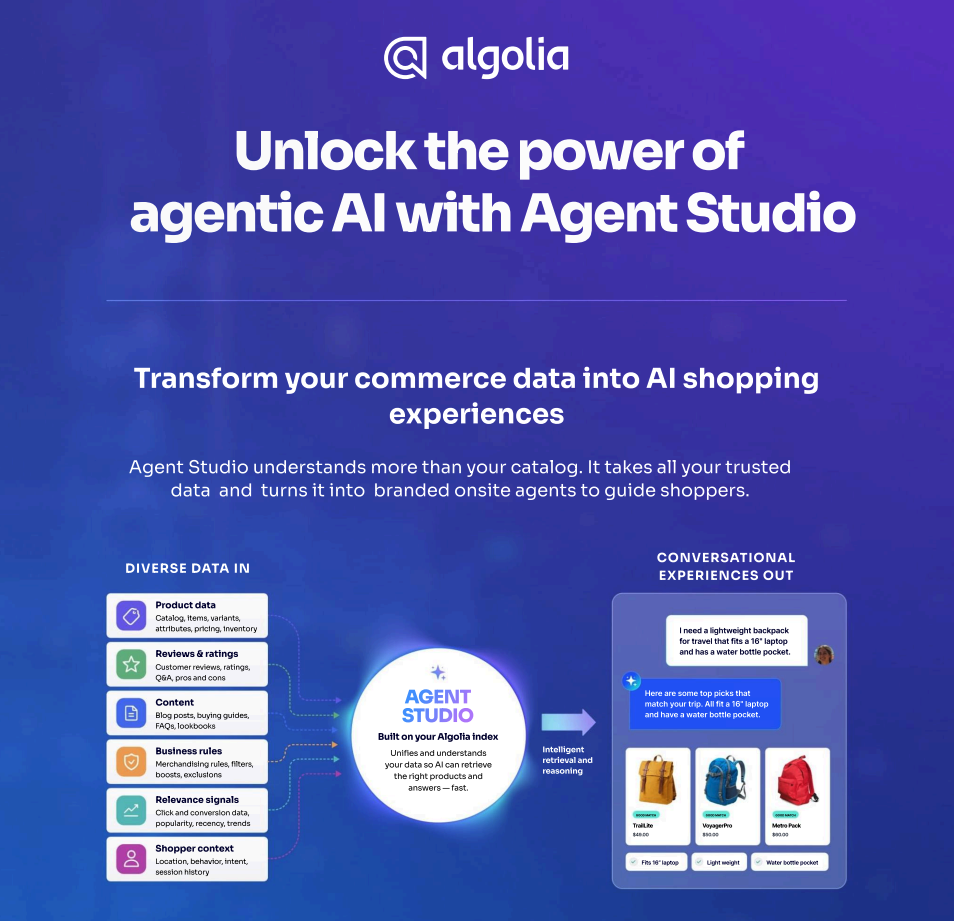
For more than a decade, Algolia made the search box fast, and we won that contest. Over the last several years, we’ve built intelligence on top of that engine (i.e., keyword, vector & behavioral, across Search, NeuralSearch, AI Recommendations, Personalization and Agent Studio).
But there has always been another side to the equation.
Behavior tells us what shoppers do. Retrieval intelligence tells us what they mean. Velou helps us understand what the product actually is.
Using multimodal AI, Velou understands product imagery & catalog content and turns it into structured, retail-specific product data (i.e., categories, attributes, values, synonyms & product relationships). And when the underlying product record gets richer, every experience reasoning over it gets better.
Velou's product intelligence will become a core layer beneath Search, Recommendations, Personalization, Merchandising & Agent Studio – continuously enriching the product understanding those experiences depend on, without requiring retailers to rebuild their existing Algolia integrations.
Velou doesn’t change Algolia’s direction, it accelerates it. This isn’t about adding another feature, it strengthens the intelligence underneath the entire platform, across more than 18,000 customers.
If you run merchandising or digital commerce, I want to be direct about what that means for you, because the reason I pursued this deal starts with a problem you live with every day.
Your customers ask for more than your catalog knows
A shopper searches for a “machine-washable navy midi dress for a fall wedding.” Your catalog says “blue dress,” a price and a size chart. You have exactly what they want, but it doesn’t surface, or sits behind 40 products that happen to be blue.
Every merchandising leader I've talked with this year knows the source of that problem. Product data arrives from hundreds of suppliers, in inconsistent formats, and usually missing the attributes customers actually search for. Your team fills the gaps—synonyms, boosts, manual tags, redirects & rules. Before long, the people you hired to merchandise the assortment are spending their time fixing the data underneath it.
I've watched teams try to solve this by hand using tagging squads, spreadsheets, agency projects, and so on. It takes months, and it never finishes, because the catalog changes every day.
What Velou changes
Velou uses multimodal AI to understand the product data you already have (i.e., text and imagery) and creates the structured attributes a merchandiser would add if they had unlimited time.
Navy. Midi. Fabric weight. Care instructions. Occasion. It maps those attributes against a curated retail taxonomy, normalizing different ways of describing the same thing into data that search, facets, recommendations & agents can actually use; and, it runs continuously as the catalog changes, at production scale, with every attribute grounded in source evidence.
That last part matters as much as the first. A confident wrong attribute is worse than a missing one—it can cost you a sale, or a return. Velou chose the disciplined path when a faster, looser one would have been easier to sell. That is the standard we will hold as we bring it to every Algolia customer.
What better product understanding unlocks
Once those details are in your records, here is what we expect you'll see:
-
High-intent queries stop coming back empty. The long, specific searches – the ones that signal a shopper is ready to buy – return the right products, for the right reasons.
-
Facets fill in. Shoppers can filter by occasion, fit, fabric or care, because the attributes finally exist.
-
New arrivals perform on launch day. Products rank on what they are, before they've earned click history – no manual boost required.
-
Rule debt shrinks. Fewer hand-written rules, synonyms and redirects to maintain, so your team's time goes to assortment, campaigns and margin – the part of the job you hired them for.
-
One product truth, everywhere. Search, recommendations and personalization reason over the same enriched record, so the dress a shopper finds in search is the one recommended next to it.
Velou's retail customers show what that looks like in numbers. U.K. sportswear retailer Get The Label added more than 190,000 product attributes over six months, and revenue from its site search rose 60%. At U.K. fashion retailer Everything5pounds, catalog attributes grew more than 85% and search conversions rose 33%.
Every catalog is different—so I won't promise those numbers to anyone—but they show what happens when the product record finally matches the way people shop.
For the executive who owns the number
Three things I'd want to know if I were in your seat.
This is not a migration project. Your APIs, SDKs and integrations stay exactly as they are – no re-platforming, no rebuilding and no new implementation work. Velou's enrichment capabilities will simply become available within the Algolia platform, working with the integrations you already have in place.
It is your AI-readiness plan—without a second data project. More shoppers now start in ChatGPT, Microsoft Copilot and Google Gemini. AI-referred traffic to U.S. retail sites rose 62% year over year in July, according to Adobe Analytics. Those agents don't browse your pages, they read your product data and they can only recommend what it describes. The same enriched record that fixes your search bar is the one that makes your catalog readable to an agent. You don't need a separate "AI data" initiative. You need a truer product record, and you need it once.
It is intelligence you can inspect. Every attribute carries its evidence. When a product ranks, your team can see why, and can fix the record instead of writing another rule. We don't believe in black-box merchandising. In an era when every vendor promises "AI," I'd ask each of them the same question: can my merchandisers see where the answer came from?
What comes next
If you want to see how this works on a real catalog, we’ll be scheduling a webinar for a live walkthrough shortly.
The next shopper who types a very specific question, into your search bar or into an AI assistant, should find exactly the product they described. That's the work we're doing now, together.












.webp)


.jpg)



%20(2).svg)