The future of AI search: Bernadette Nixon on BBC <em>Talking Business</em>
Listen to this blog as a podcast:
When BBC presenter Mark Lobel sat down with Bernadette Nixon, CEO of Algolia, for a recent episode of Talking Business, the conversation quickly turned to one of the most pressing questions in technology today: how AI is transforming the way we search, shop, and interact online. If you're in the UK, you can watch the interview here. Or, get a recap below.
Algolia, serving over 18,000 customers worldwide, is no stranger to scale. The company powers the search experiences behind some of the world’s most recognized brands—PayPal, Slack, Adobe, and in the UK, Asda, Gymshark, and Boots. As Nixon explained, Algolia is “the world’s largest AI-powered search for websites and embeddable applications.” Put simply, if Google or ChatGPT brings you to a company’s site, Algolia takes over from there.
Beyond the search box
One of the key takeaways from the interview is how far search has come from its early days. Most people still picture a search box tucked in the top corner of a webpage. But Algolia is already powering experiences far richer and wider than that.
Whether it’s browsing categories like handbags, engaging in natural language conversations with an e-commerce site, or soon—delegating tasks to agentic AI systems—search is no longer static. “We’re building experiences that feel as fluid as a conversation with a person,” Nixon explained.
AI as a business partner
For companies, the power of AI search extends well beyond helping individual users find the right product. Algolia delivers insights into consumer behavior, surfacing affinities for brands and highlighting trending items. That data can then shape merchandising decisions, personalize customer experiences, and even automatically update what shoppers see online.
In Nixon’s words, the infrastructure itself is becoming decision-making intelligence—not just reporting insights but acting on them.
The rise of agentic AI
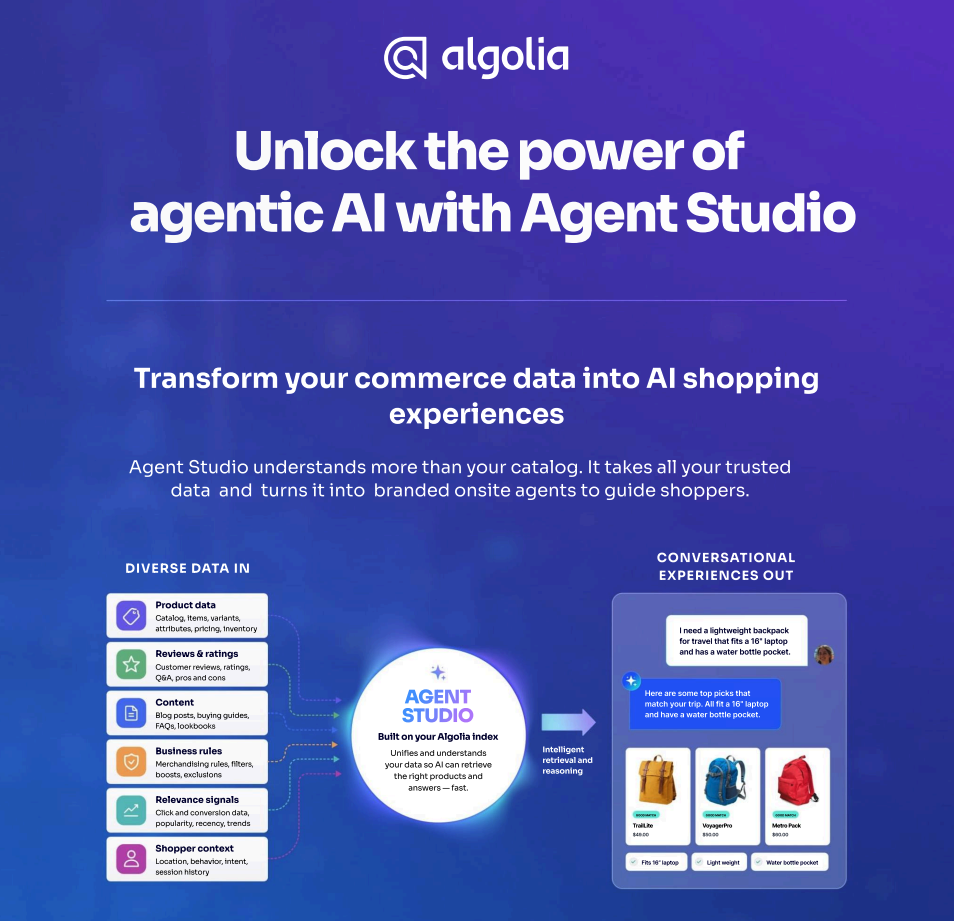
Perhaps the most striking part of the conversation was Nixon’s view of where search is heading. Today, websites are designed for humans. But in the near future, they’ll also need to be designed for AI agents—autonomous digital assistants that can interact, decide, and transact on our behalf.
Imagine asking your shopping assistant—on smart glasses, a phone, or a browser—to “buy trousers like the pair I got last autumn, but in a deeper shade.” The AI agent will understand size, preferred brands, buying history, and payment details, then complete the purchase.
According to Nixon, this shift to agent-to-agent interactions could become the norm within just one to two years.
AI and search: Not either/or
A question on many minds is whether AI chatbots will replace traditional search engines. Nixon was clear: it’s not an either/or choice.
For high-intent searches—like a parent looking for size two nappies—traditional search is faster and more efficient. For inspiration-driven searches—like finding a Mother’s Day gift—conversational AI feels more natural. The future is about offering both experiences, tailored to the user’s intent.
SEO and the AI surge
The conversation also touched on SEO, a discipline some suggest AI might soon make obsolete. Nixon disagreed. SEO remains critical—most web traffic still flows through it. At the same time, she highlighted an extraordinary figure: a 4,700% increase in traffic from generative AI sites like ChatGPT in just one year.
The message was clear: businesses can’t afford to ignore SEO or AI. Success will require mastering both.
A carpe diem moment for AI
The interview closed with urgency. “In every wave of innovation, there are early adopters and laggards,” Nixon reflected. “But this time, the curve is unlike anything we’ve seen before. It’s an AI arms race. It’s do or die. Carpe diem.”
With agentic AI, autonomous decision-making, and unprecedented infrastructure demands on the horizon, businesses face both risk and opportunity. As Nixon put it, the time to act is now.
Conclusion
Bernadette Nixon’s conversation with Mark Lobel offered more than a glimpse into the future of search—it underscored how rapidly that future is arriving. From AI-driven personalization to agent-to-agent commerce, the rules of engagement online are being rewritten. And for companies willing to adapt, the opportunity is immense.




.webp)


.jpg)













%20(2).svg)