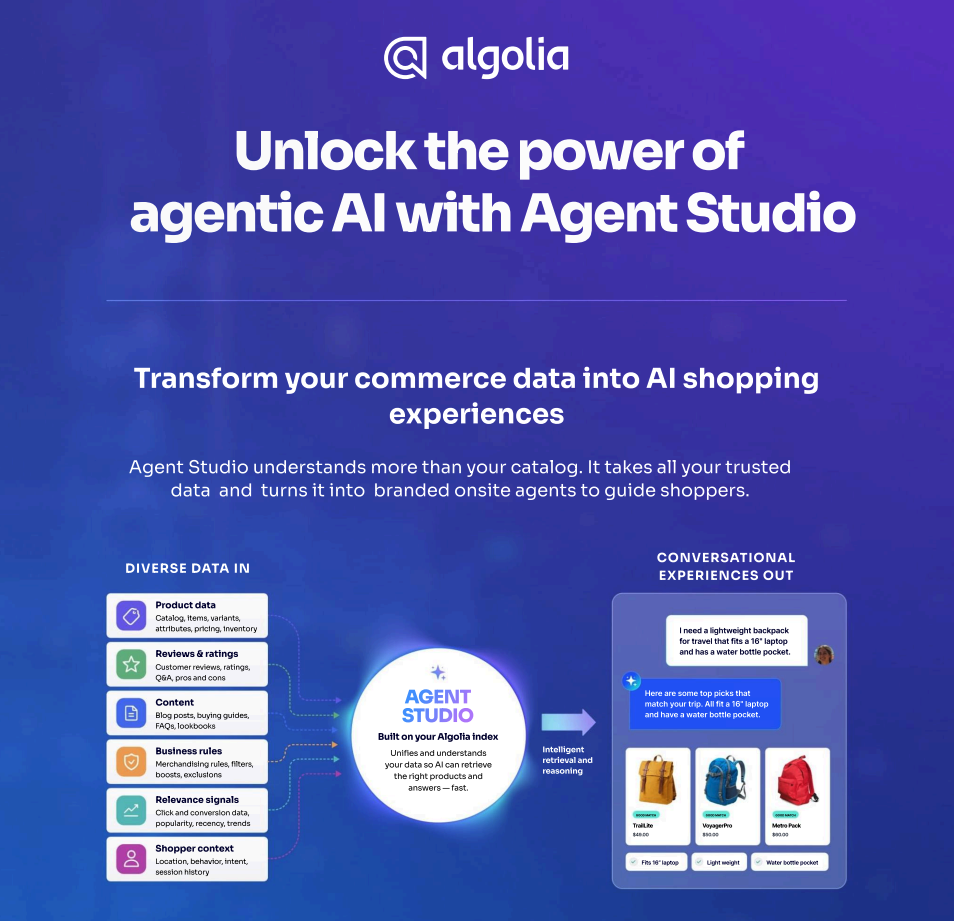
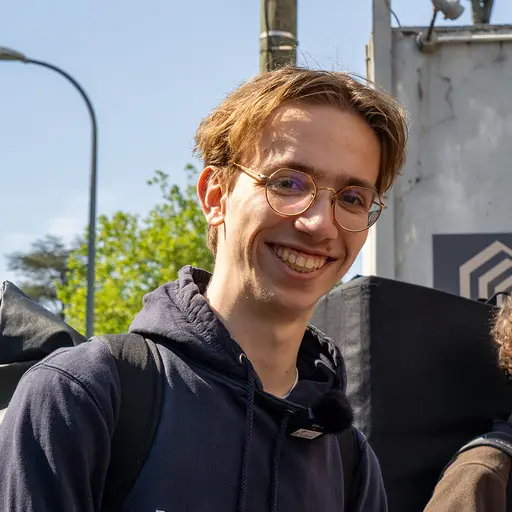
Hey! I’m Paul, a final-year engineering student at Efrei Paris, and I spent six exciting months with Algolia’s Generative AI team, discovering Agent Studio, applied research, and what it really means to be part of the team. Here is my experience.
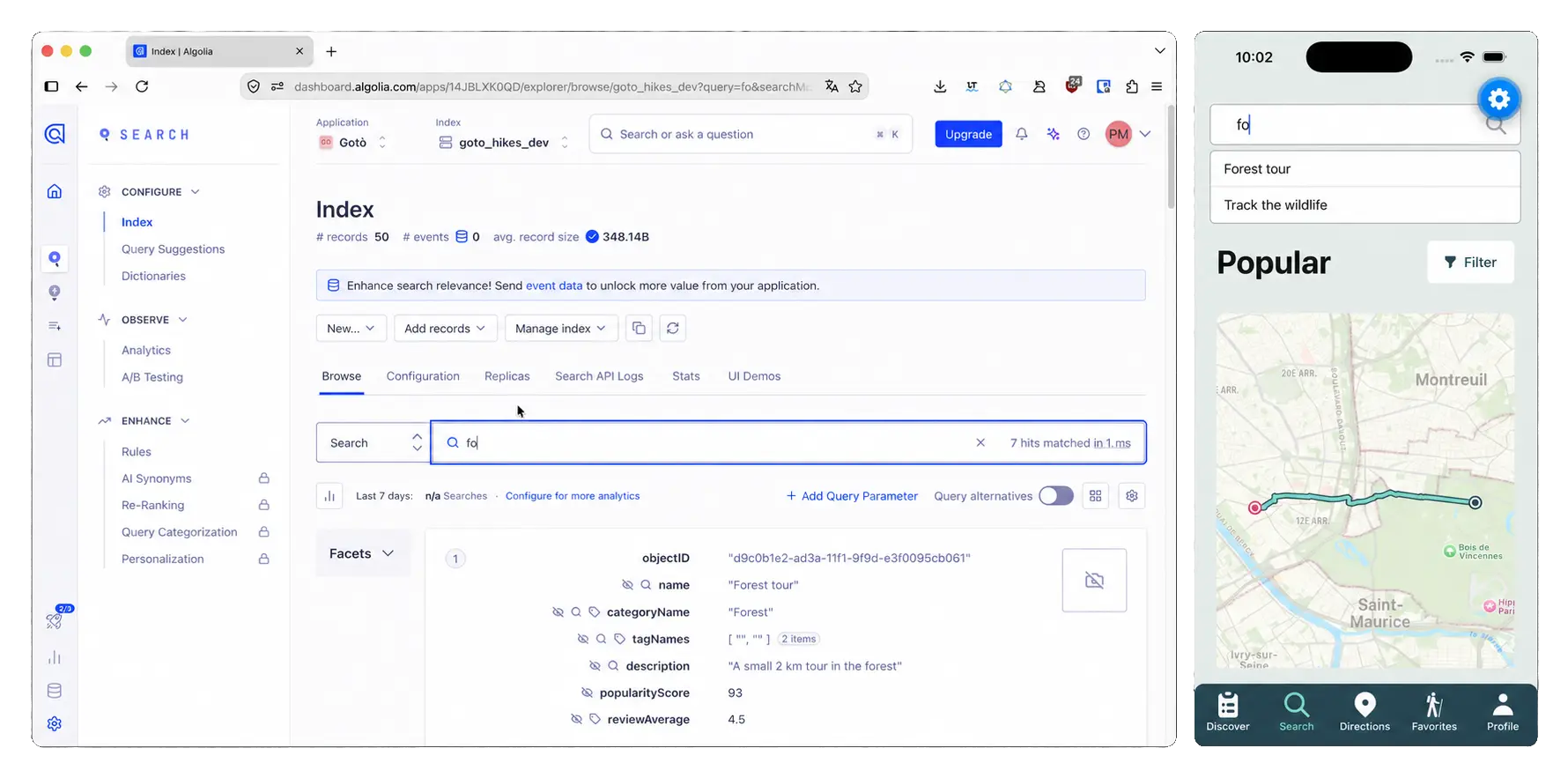
For onboarding, the team suggested I set up an application to learn how Algolia works. I wanted to start with something I know quite well, so rather than using a generic ecommerce app, I went back to a hiking application I had built as a student.
The application already had search functionality, technically: a basic database query that returned matching hikes. It worked, but it was far from the experience people expect from a real product.
I used that application to discover Algolia. I connected its data, made the results update instantly, added facets, and experimented with click and conversion events to personalize and rerank the results. The project was small, but the conditions were real: I knew the data and could immediately see what each feature changed.
That freedom made the onboarding more concrete. It also made my questions more useful.
During another onboarding discussion on Agent Studio's code, I asked about a case where part of the implementation setup did not seem to run how it should. We examined it, confirmed the issue, and the team helped me turn the investigation into a backlog ticket. We followed the question until we understood what was happening, then left a trace for the team.
This small episode captured much of what followed. I did not spend my internship waiting to become useful. From the beginning, I was given the space to explore, the resources to test my ideas, and the expectation that my observations could contribute to the product.
Looking back, the experience can be read through Algolia's five values: Trust, Grit, Candor, Humility, and Care. They did not appear as abstract principles but shaped my experience.
Trust: Being given a question, not a ticket
After onboarding, I joined the team working on Agent Studio. I was not given a feature specification with an implementation already selected. I was given a question: does splitting one AI agent into several specialized agents create enough value to justify the added complexity?
I remained responsible for how to answer it. I organized my work, adapted the schedule, designed the evaluation, and decided which phases deserved more time. I could move quickly when one part was sufficient and change the plan when another needed deeper investigation.
Trust did not mean working alone. My discussions with Raed, my internship mentor, focused on the decisions that could change the rest of the project: how to frame the problem, what to compare, whether a result was reliable, and whether an experiment still deserved more time. But I was expected to arrive with my own position, supported by a document, a prototype, or evidence we could discuss.
The same principle applied outside my main subject. In meetings, my ideas were considered on their merits, including on other parts of the product. People listened and challenged them as they would those of any other team member.
Lesson learned: Interns here are not only trusted with a task.They are trusted with a question and with the responsibility of deciding how to answer it.
Grit: Evaluating the evaluation
Building the first proof of concept was relatively quick. It showed that the architecture was possible: one agent could delegate work to others, and the complete system could produce an answer.
But “it works” was not the question I wanted the internship to answer.
The important question was whether this architecture was useful. Did its benefits compensate for the additional steps and complexity, or did it only look cleaner on a diagram? The Algolia engineering team understood that getting to the immediate outcome took a backseat to spending time analyzing and understanding the problem. I had the autonomy to pursue the questions that were important, and the guidance to stay on track.
I therefore spent much more time on evaluation. I reviewed individual cases, compared what had happened with what the evaluator claimed, and audited how the final result was produced. This became the most important part of my internship.
Lesson learned: Grit was doing the slower work after a convincing-looking result already existed: reopening cases, questioning the instrument, and refusing to stop until I understood what the numbers could honestly support.
Candor: Making uncomfortable results useful
The first evaluation result was almost the opposite of the starting hypothesis.
After months spent studying multi-agent architecture, this would have been an uncomfortable conclusion. It would also have been easy to search only for reasons to dismiss it.
Fortunately, the work did not depend on the original hypothesis winning. The result could be discussed openly because the team challenged the work without turning that challenge into a judgment of the person behind it.
Candor meant preserving that nuance. We did not present the first negative ranking as unquestionable simply because it came from an automated benchmark. We also did not present the audit as proof that the architecture was now positive on every axis. We separated what we had observed, what we could reasonably infer, and what the experiment had not tested.
Lesson learned: There was no pressure to turn the internship into a success story by making the technology look better than it was. A reliable trade-off was still a good result. Knowing where an architecture helps, where it costs more, and when not to use it is something a team can build on.
Humility: Keeping the architecture, changing the reason
The nuanced result did not mean throwing the architecture away. It meant changing the job we expected it to do.
The architecture became less about reorganizing current internal capabilities and more about opening a boundary toward external ones.
Lesson learned: Humility, in this case, did not mean abandoning the solution as soon as the initial explanation weakened. It also did not mean defending that explanation because we had already written the code. We kept what remained useful and allowed the evidence to change the reason for using it.
Care: Opening doors, then helping me walk through them
Throughout the internship, the team did more than support the project. It created opportunities for me to make the work visible and to explore ideas beyond the original subject.
I developed a side project around agent memory and was invited to present it during an internal AI Quick Take. I was also encouraged to turn the lessons from my internship into articles like this one and to share my work with other teams.
These opportunities came from both sides. Someone would open a door and ask whether I wanted to present, publish, or explore an idea. It was then my responsibility to prepare the work and walk through it, with encouragement and help when I needed to understand the next step.
The support was also material. Model access, APIs, and large evaluation campaigns can be expensive. When I could explain why an experiment mattered, Algolia's team helped put the resources in place so that I could test it properly.
Care was therefore an investment in my ability to contribute. The team gave me visibility without speaking in my place, resources without taking ownership of the investigation, and guidance without reducing the project to a safe list of tasks.
Lesson learned: The message was simple: if you believe an experiment is worth running and can explain why, we will help you get the means to verify it.
A real project to be proud of
Before joining Algolia, I imagined research as something more isolated and abstract, separated from the product and from the people who might eventually use the result.
Research inside a product team felt very different. The question was real, the cases were concrete, and the feedback loop was short. I could build an idea, test it, discuss the result with the team, and see that result change an architecture or a product direction. The work remained rigorous without becoming disconnected from practice.
I did not arrive doubting my ability to build software. The internship confirmed something different: I could own a professional project and take a research question from its initial uncertainty to a conclusion that other people could build onto.
It also showed me that research and innovation are not reserved for a particular title. With a real question, a rigorous method, and an environment that trusts you, a young engineer can do more than simply follow a predefined internship plan. Read more about my exploration of monolithic vs distributed agents.
That is what I would want a future intern to know about Algolia.
I came to Algolia wanting to build and discover what research looked like in practice. I leave with a real experience, a complete project, and something I am proud to call my own.
But, the story won't end there.... While not every internship ends with a job offer, mine did, and I’m happy to say that I’ll be joining the Algolia engineering team soon to continue learning and contributing to Algolia’s agentic capabilities!











.webp)


.jpg)


%20(2).svg)