There's a specific kind of friction you get used to when shopping online.
The filters are there, but they're just not quite the right ones. You find something close enough, apply it, and get on with it. It's a small thing, but it happens across every search, for every person on your site, and that quiet accumulated friction is almost impossible to see in a company’s analytics. It doesn't show up as a problem, it just shows up as slightly lower engagement than it could be.
The reason it's hard to fix is that the right filters are genuinely contextual, and a static configuration — built once, based on reasonable assumptions about what most people want — can't handle that.
Here's a concrete example of what that looks like in practice.
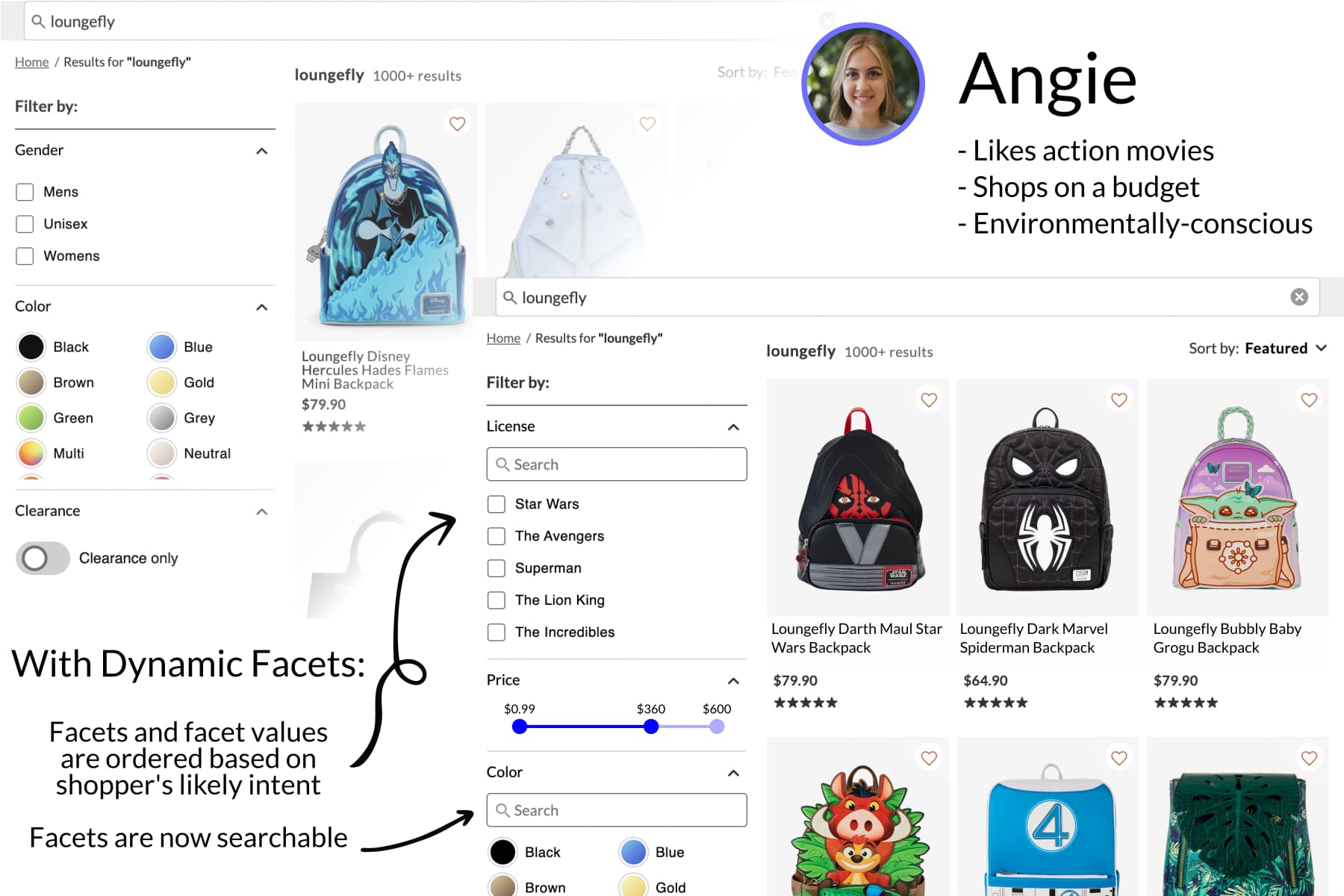
Angie searches for "loungefly" on an ecommerce site. The static panel gives her Gender, Colour, and Clearance — not wrong exactly, just not what anyone searching for Loungefly actually cares about. Loungefly is a licensed character brand, and the decision people are trying to make is about License: Star Wars, Marvel, Disney, The Lion King. With Dynamic Facets enabled, that's what would surface first, because that's what users searching "loungefly" actually reach for. The system learns from real search behaviour across that query and reorders accordingly — so the filter panel reflects how people actually shop, not how the catalogue was organised at implementation.
That's the gap Dynamic Facets closes. Rather than showing the same fixed set of filters to everyone, it reorders them in real time based on what people are searching for and how they behave.
In beta testing, the results were consistent: users clicked earlier and more often. In the strongest cases, clickthrough rate on specific filters improved by 10 to 15 percentage points, with users reaching results sitting two to three positions higher up the page. It’s the friction that it helps with. A small but persistent drag on engagement, in a place most teams haven't thought to look.
There's an operational side to this too. Keeping facet orders current across a catalogue that's constantly shifting — new inventory, seasonal demand, changing search behaviour — is the kind of maintenance that's easy to deprioritise, so it helps with the manual upkeep. A useful side effect also emerged: A/B testing Dynamic Facets allows you to see where it produced large gains. Perhaps it was a specific category that may need looking at. Standard analytics don't surface that, but a live A/B test does.
Dynamic Facets is available now. If your filter panel hasn't been meaningfully revisited since launch, it's worth finding out what that's been costing you. Run a test, let the data show you where the gaps are, and go from there. Learn more about configuring Dynamic Facets in our docs.




.webp)












%20(2).svg)