AI is reshaping ecommerce in real time, but how are B2C players turning it into a competitive advantage?
AI-powered features have demonstrated strong value in B2C ecommerce, with steady demand across markets and regions. As emerging solutions such as agentic AI improve capabilities and open up new possibilities, interest in AI-driven features continues to grow.
Our B2C Ecommerce Site Search Trends Report uncovers how companies are leveraging the possibilities of search and AI to create powerful growth engines.
Investment in AI-powered search is rising
Focused on generating meaningful connections and unforgettable shopping experiences for their customers, ecommerce B2C businesses are in the midst of a 6% year-over-year increase projected through 2026.
Driving this growth is a stronger focus on revenue, cited as a critical incentive by 58% of B2C organizations, up 9% since 2024.
While 53% will be maintaining ongoing levels of search investment, 39% are accelerating their AI adoption and commitment to search implementations.
In that move forward, 49% of ecommerce B2C businesses are taking advantage of the capabilities, flexibility, and easy integration offered by third-party AI-powered search providers.
Using AI to balance the art and science of merchandising and ecommerce sales
While the B2C ecosystem is undergoing significant shifts, companies are looking to improve bottom-line results by maximizing the potential of rapidly advancing capabilities like agentic AI.
The convergence of more intelligent technology, deeper personalization, and an uncompromising focus on customer experience is raising the standard—one that forward-thinking organizations are already gearing up to meet.
From improving the quality of customer interactions to empowering merchandisers with rich data and AI-driven tools, the future of ecommerce search and discovery in 2026 is all about improving internal processes and exceeding customer expectations with the help of creative, AI-powered solutions. Let’s take a look at the details.
The AI outlook and ecommerce search
AI continues to be a big deal in search. It comes as no surprise that AI has been playing an increasingly important role in powering the search and discovery journey for B2C businesses and their customers. Data from our recent site search trends report confirms the growing integration of AI-powered solutions across online ecosystems for B2C businesses around the globe.
Agentic AI implementations are increasingly popular
In 2025, more than 60% of B2C organizations reported plans to deploy agentic AI within the next 12 months. These advanced AI systems are being embraced for their ability to drive faster, smarter, and more personalized customer experiences while improving operational efficiency.
Personalizing the search experience remains a priority
As generative AI becomes increasingly embedded in digital ecosystems, B2C organizations are leveraging it to deliver tailored, real-time interactions across the buyer journey. Across markets, improving search, payments, and personalization are digital priorities. Notably, 42% of respondents are focusing on using AI to better understand user intent, up from 34% in 2024.
Gen AI is positively impacting the sales funnel across markets
Alongside agentic AI, 9 in 10 B2C businesses consider gen AI very or somewhat important to generating a personalized user experience for their customers and end users—an approach that shows little variance across markets and geography.
AI is an important strategic driver
Overall, 63% of respondents believe that shoppers are more likely to complete a purchase when using gen AI-supported systems. In comparison, 50% acknowledge a direct link between AI-powered intent recognition and increased revenue.
AI is all about improving UX and insights for customers and the team
AI will increasingly handle real-time data processing, but its effectiveness will hinge on how seamlessly it integrates with existing backend systems and workflows. Organizations recognize that without flexibility and user-friendly implementation, even the most sophisticated AI solutions will struggle to generate meaningful impacts and bottom-line results.
AI and consumer search behavior
Data from the B2C Ecommerce Site Search Trends Report demonstrates that across all regions shoppers are more likely to convert and complete a purchase when using AI-powered tools, with agreement ranging from 68% of respondents in the United States to 57% in New Zealand and Australia.
In addition to improving analytics and insights, AI and search and discovery investment is based on the technology’s ability to enhance the consumer experience and better help customers find the items they need.
Image drives almost everything, and AI drives purchase likelihood
When asked to rank the most beneficial AI-powered search solutions, respondents invariably ranked “search by image” as the most valued feature at 91%. Nearly tied for second place, AI-powered personalized recommendations and AI assistants or chatbots were seen as valuable by 78% and 77% of respondents, respectively.
Search using all the senses: Image-based search is increasingly popular
The findings point to a shift toward multi-modal search, with consumers seeking greater flexibility in product discovery. Conversational AI and traditional text-based search lead equally at 52%, while image-based search follows closely at 51%, highlighting the growing role of visual and blended search experiences.
Though text-based search remains popular, image-based search is favored by users in New Zealand, Australia, and the UK. This reflects the growing appeal of visual search, where uploading or tapping a photo to find similar products has become an increasingly common way for consumers to discover and compare items on ecommerce sites.
Voice search using digital assistants is more common in the US
In the United States, voice search—using digital assistants like Alexa, Siri, or Google Assistant—ranks in the top three preferred search methods.
AI inside B2C
While the rapid expansion of AI capabilities is fundamentally reshaping consumer expectations, personalization remains an important part of the online shopping experience. It comes as no surprise that over 70% of B2C organizations globally report being very and quite satisfied with their AI-powered search and discovery investments.
AI is positively impacting all markets
Consistent across markets, the importance of generative AI is underscored by the fact that 94% of respondents consider it very or somewhat impactful in bolstering customer loyalty and repeat purchases, positively influencing purchase decisions, and powering conversational tools that support the purchase journey. Across all use cases, perceptions of generative AI’s positive impact show little to no variation by market or geography.
However, one key area of differentiation is the type of search solutions B2C businesses are choosing, including implementations that allow for multi-modal search capabilities. Nearly half (49%) are opting for third-party providers, citing a strong preference for scalable, proven platforms that provide flexibility, next-generation capabilities, and seamless integration. This outpaces those building in-house (27%) or using off-the-shelf software solutions (23%).
FOMO is driving search and AI investment
Respondents report that the fear of missing out (FOMO) is having a major influence on digital strategy. In 2025, 39% of businesses accelerated AI adoption and search investments to stay competitive. Meanwhile, 53% reported already making strong search investments, consistent with 2024 levels.
Human and AI together
While AI is central to the future of B2C commerce, human judgment remains critical, especially in areas like brand strategy and merchandising. AI will take on more of the real-time data processing, but success will depend on its ability to integrate smoothly with existing backend systems and workflows. Businesses are aware that without adaptability and ease of use, even the most advanced AI solutions will fail to deliver impact.
As we head into 2026, brands that can integrate intelligent technologies while keeping human insight at the center of business strategy will be best positioned to win the loyalty of tomorrow’s consumer while generating meaningful bottom-line results.
Innovation and agentic AI
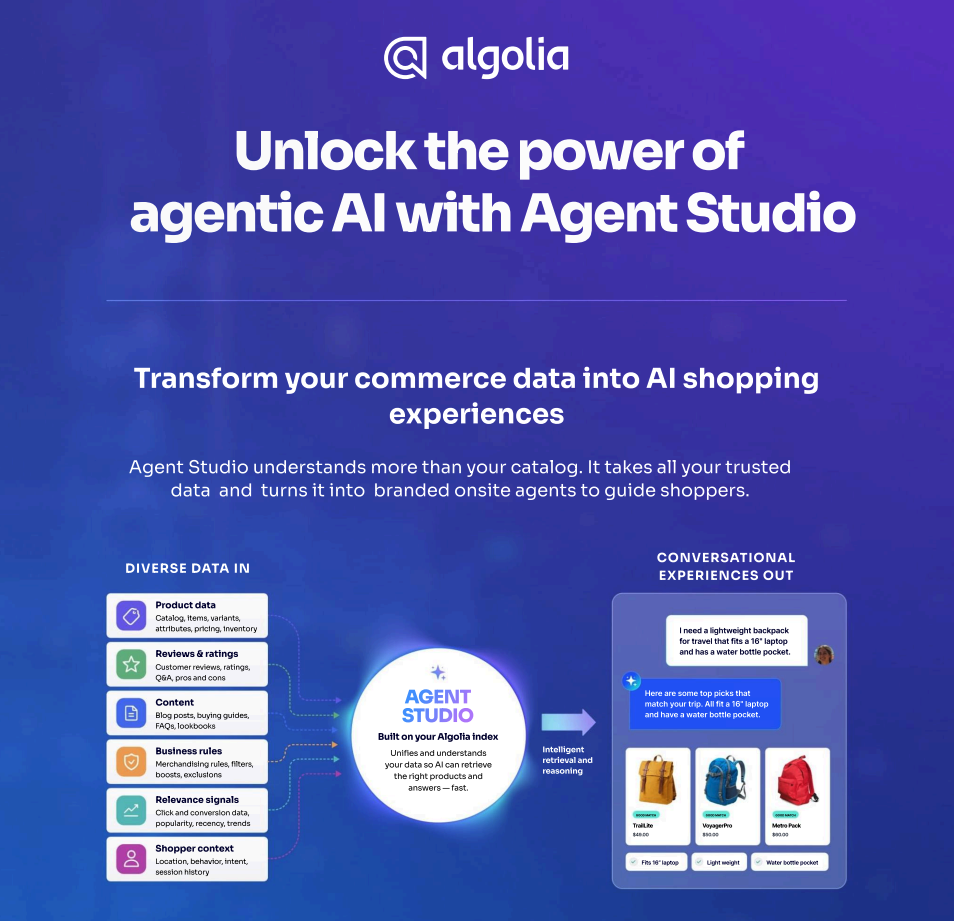
With merchandisers and business teams eager for AI tools that go beyond basic analytics to provide actionable insights, agentic AI provides advanced data interpretation and automation capabilities— freeing teams to make more strategic decisions.
Through a combination of smarter AI, stronger personalization, and a relentless focus on the user journey, organizations can better meet and ideally exceed customer expectations.
B2C organizations are getting started with agentic AI
Currently, only 17% of B2C ecommerce retailers have deployed agentic AI search systems. However, adoption is projected to increase significantly, with 61% planning implementation within the next 12 months. Notably, only 1 in 5 respondents report no concrete plans for agentic AI initiatives, highlighting a clear trajectory toward broader adoption across the sector.
Agentic AI implementations are being shaped by integration concerns
When asked about the key factors influencing the adoption of agentic AI search systems, respondents identified three major considerations:
- Smooth and efficient system integration: 47%
- Ensuring retailer control over technology: 37%
- Return on investment (ROI): 39%
Conclusion: The future of AI-powered search
As the power of AI reverberates around the world, the technology has already positively transformed the B2C search and discovery ecosystem.
AI-powered capabilities are proving their worth across global B2C ecommerce markets. Alongside new agentic AI capabilities, the interest and utility of AI-powered solutions will continue to surge into 2026.
From establishing new baseline standards for customer interactions to leveraging agentic AI that empowers merchandisers with actionable data and solutions, the customer journey is being positively transformed. The future of search and discovery is all about exceeding customer expectations and generating bottom-line results by creatively harnessing AI-powered solutions and capabilities.
About the full report
The B2C Site Search Trends Report takes a detailed look at the critical issues driving search and discovery for retail and ecommerce businesses in key North America, Europe, and APAC countries.
Based on data assembled from an equal number of IT and business decision makers, respondents included CIO, CTO, and CDO officers responsible for driving search and discovery in ecommerce businesses with revenues ranging from $100 million to $5 billion.
Get the report




.webp)


.jpg)










%20(2).svg)