Within user experience (UX) design, seamless, frictionless experiences has long been the north star vision. Thought leaders across the industry sing its praises and design teams create principles around it.
Designer teams build for ease of use and measure its effectiveness through standards like the system usability scale (SUS) and customer effort score (CES).
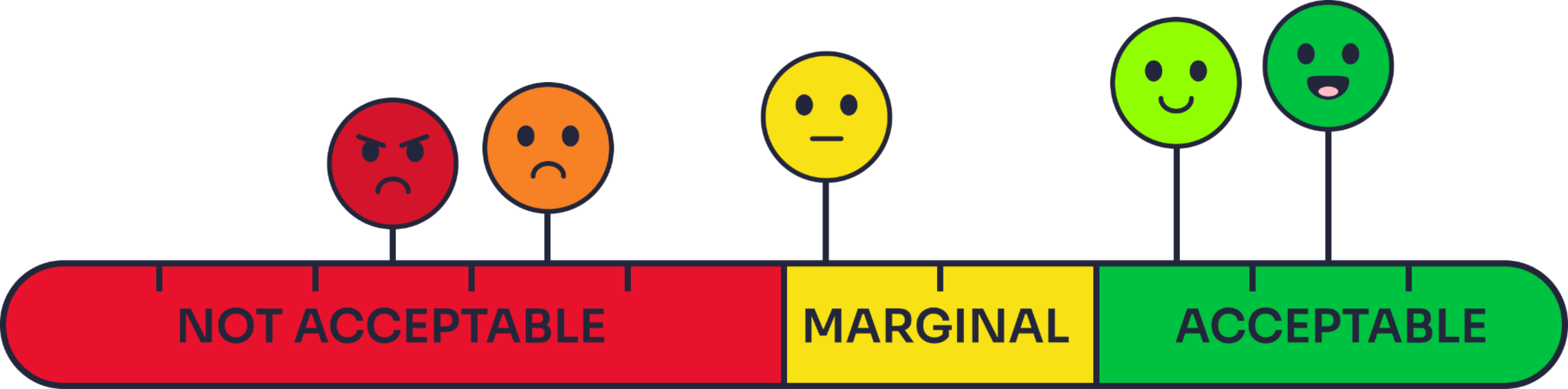
SUS scoring measures efficiency, intuitiveness, ease of use, and user satisfaction.
Users expect interfaces that allow them to effortlessly achieve their goals without stumbling over obstacles. But what happens when that standard model fails? Friction can actually be an effective way to help users slow down, pay attention, and learn. With the increasing rise of AI-based experiences, we are recognizing that friction should no longer be universally avoided, but can be a powerful tool to create successful experiences. Hence the rise of ‘conscious friction’ – deliberate, thoughtfully designed obstacles that enhance user experiences rather than impede them.

Airbnb’s effortless user interface is informative yet simple to use.
The myth of frictionless
In the past, UX designers have aspired to create interfaces so intuitive that users hardly notice transitions between actions. While this approach works well in many scenarios, the advent of AI has illuminated drawbacks of this seamless paradigm. It turns out users are not always best served by interfaces that shield them from the paradox of choice.

Sheena Iyengar and Mark Leppe’s jam study revealed that choice overload can cause anxiety among customers.
The frictionless myth imposes a one-size-fits-all model for user experiences. This neglects the diversity of user needs, preferences, and contexts. AI-powered interfaces, however, demand a nuanced understanding of user interactions. By acknowledging and embracing conscious friction, teams can craft interfaces that cater to individual users' cognitive needs, fostering engagement and satisfaction.

A non-coder that is comfortable working in a development environment may feel that a binary option doesn’t consider their exception.
Cognitive lift and decision-making
One of the key tenets of conscious friction is the importance of cognitive lift in the user experience. Cognitive lift refers to the mental effort required for a user to process information and make decisions. While reducing cognitive lift is often a goal in UX design, it's crucial to strike a balance. Too little cognitive lift can result in an uninformed and disengaged user, while an overload may lead to frustration and abandonment.

Microsoft’s ambitious Windows 8 operating system received a lukewarm reception on release. Its separate environments for keyboard and touchscreen led to cognitive overload for many users.
AI-based products involve complex algorithms and decision-making processes behind the scenes. To maintain transparency and empower users, developers can introduce conscious friction elements such as providing insights into AI-driven recommendations or presenting choices that invite user input. This creates an experience that acknowledges the user's intellect and gives a sense of control, fostering trust in the product.
There are multiple cognitive principles that help us understand when and how increasing friction and cognitive lift is beneficial.
With the Logo Creator GPT in Dall-E, users can give AI full control, choose from multiple options, or add additional data throughout the creation process.
Action bias
Humans inherently prefer to take action over inaction. In an unpredictable world where people often lack control, taking action increases their sense of control and safety. This is particularly relevant when it comes to AI, where users can feel an urgent and alarming loss of control.
The pioneers of ‘action bias,’ Patt and Zeckhauser, proposed that humans developed this cognitive principle because it helps them learn. Doing something, even when they have the option to do nothing, improves their ability to generate positive outcomes in similar situations in the future. Anxiety about AI makes the desire to learn and act even stronger though this sentiment might diminish over time as AI becomes more familiar. Therefore, while it’s tempting to design your AI experience as quickly and easily as possible, doing so removes this learning option that is critical for the users’ success and trust of the AI.

AI Search A/B testing set up process to compare the AI model to traditional keyword search.
Development teams can see this motivation for action when it comes to testing, particularly with AI experiences. Testing is one of the best actions you can take when it comes to refining AI experiences. By running tests, you make the primarily invisible experience of the AI model into something that is concretely visible: results and metrics which enable you to alter, refine, and improve the experience.
Looking at Algolia’s AI Search you can see the importance of tiered testing. Starting with a preview, you can use mock queries to help you more deeply understand the results of the AI model. Next, you can launch an A/B test to see the impact of the model at scale with your users. Each of these steps slow down the process of launching AI. However, they give you critical insight that allows you to understand, trust, and collaborate with the AI.
Spacing effect
Society as a whole is collectively learning to use AI simultaneously. For that learning to be effective, AI can’t be taught through a single interaction. For your users to retain information over time, they need to be continuously reminded. ‘Spacing effect’ is one of the longest recorded cognitive principles, first identified in 1885. Your users forget 80% of new information within 24 hours. Therefore, to retain knowledge of the concepts, UI, interactions, and skills needed to be successful with AI, they need to see that same information repeatedly over time.
To see ‘spacing effect’ in action, you don’t have to look any further than Algolia’s Dynamic Re-Ranking. By using progressive disclosure to understand predicted scores, every interaction provides users with a reminder about the core lessons they learned in their onboarding.
The experience would have less ‘friction’ by just displaying the product rankings. However, by adding the predicted attractive scores and info icon, it provides continuous learning opportunities for users.

Dynamic Re-Ranking’s criteria for attractiveness is easily found via mouse hover.
Choice overload
Users generally perceive choice as a gift, allowing them to customize and pick the option that's best suited for their precise needs. Endless options are great for topics in which they are experts with the pre-existing knowledge to know EXACTLY what they are looking for, allowing them to quickly wade through all the options. In other cases, options are more of a curse than a gift. There are two common situations where this happens:
-
There are many different ways to approach the situation
-
Starting with a blank page where the options are literally endless
When users don’t have the expertise to quickly wade through every option, conscious friction can help them slow down to make informed choices.
One of the most common solutions is wizards, which break the complexity down into steps. Looking at Algolia’s AI Recommendations, you can see that chunking the process into smaller steps mitigates the complexity that exacerbates cognitive overload.


AI Recommendations setup wizard breaks down model complexity into multiple simple steps.
CONCLUSION: Navigating The future
Users benefit from being active participants in the decision-making process. As AI continues to evolve and shape user experiences, utilizing conscious friction helps developers create powerful solutions. By dismantling the myth that ‘frictionless is always best,’ you give yourselves the opportunity to build more nuanced solutions, rather than adopting a one-size-fits-all solution.
As builders of user experiences, embracing conscious friction requires a deep understanding of cognitive principles and their implications to user interaction with AI. By incorporating intentional points of friction, we empower users, enhance transparency, and pave the way for more inclusive, adaptive, and trustworthy AI-infused experiences. Navigating this balance between seamlessness and deliberate friction will define the future of user-centric products in the age of artificial intelligence.



.webp)










%20(2).svg)