The rise of generative AI and LLMs
Artificial Intelligence (AI) is no longer a visionary concept of the future — it’s here, evolving rapidly, and changing how we live, work, and shop. Among the most impactful advancements in AI are generative AI (genAI) and Large Language Models (LLMs), which now impact our daily lives, whether through AI-generated text, images, or virtual assistants. These technologies have sparked transformative changes across industries, with ecommerce being one of the significantly affected sectors.
This eBook provides a comprehensive overview of genAI and LLMs, clarifies their differences and synergies, and explores their profound effect on the ecommerce industry. Whether you're a developer, business leader, or marketer, understanding what these cutting-edge technologies offer for ecommerce is essential as they continue to shape the future of digital interactions.
Understanding GenAI – how it works and why it matters
GenAI is a form of artificial intelligence that doesn’t just analyze or categorize data but creates something new — whether it's generating human-like text, producing realistic images, composing music, or even writing code. This creative potential is possible because of advancements in machine learning techniques, particularly deep learning and neural networks.
The foundations of genAI
GenAI relies on deep neural networks to process massive datasets. These networks learn patterns, styles, and structures from data, allowing the AI to produce new outputs based on the input it’s received. Models like variational autoencoders (VAEs) and generative adversarial networks (GANs) have played critical roles in this development.
While VAEs were crucial in generating realistic images and speech in the early stages, GANs brought forth a major leap in AI's creative abilities by allowing two neural networks to compete against each other, refining the quality of the generated content.

VAEs are an early generative model that learns to compress data and then recreate new, similar data.

Examples of genAI
- ChatGPT: Developed by OpenAI, ChatGPT is widely recognized for its ability to generate human-like text. It has found numerous applications, from answering questions to generating marketing copy.
- DALL-E: Also developed by OpenAI, DALL-E creates images from text descriptions, enabling users to visualize scenes, objects, or art that might not even exist in reality.
- MidJourney: This tool allows users to generate artistic images using high-level inputs, enabling creators to explore new ideas for projects like logo design, illustration, or branding.
These examples highlight the vast potential of genAI across various creative domains. From marketing to education and entertainment, the possibilities are nearly limitless.
The genAI process
At the heart of genAI is a process that starts with a massive dataset for training. These datasets include books, articles, images, videos, and other types of content depending on the model’s purpose. The AI then learns the underlying patterns in this data, which allows it to generate content that mimics the style and form of the original data, but without directly copying it. The "creativity" of the AI comes from this ability to generate something new yet contextually and stylistically relevant.
The process is powered by LLMs and machine learning algorithms that convert sentences and data into numerical representations called vector embeddings. These embeddings allow the AI to find relationships between words and concepts, enabling the generation of coherent and contextually appropriate content.
Large Language Models (LLMs)
– the backbone of genAI
LLMs represent a class of AI models designed to understand, process, and generate human-like text. These models are at the core of most text-based genAI applications, including ChatGPT and Google’s Gemini. LLMs are trained on vast amounts of textual data and use natural language processing (NLP) techniques to generate contextually accurate and fluent responses.
How LLMs work
LLMs work by converting text into numbers, which represent different elements of language. Using transformer architectures — a deep learning technique introduced in models like GPT (Generative Pre-trained Transformer) — LLMs can process text in parallel rather than sequentially, making them incredibly efficient at understanding context and relationships between words. These models are pre-trained on a massive corpus of data and can then be fine-tuned for specific applications such as translation, summarization, or chatbot responses.
Key examples of LLMs
- GPT-3 and GPT-4: Developed by OpenAI, these are some of the largest and most powerful language models. They are capable of producing coherent, contextually rich text that is nearly indistinguishable from human-written content.
- PaLM (Pre-trained AutoRegressive Language Model): Google’s PaLM represents an alternative approach to LLMs, focusing on tasks like language modeling, document classification, and content summarization.
The synergy between genAI and LLMs
GenAI and LLMs might seem like separate technologies, but they often work together to enhance each other’s capabilities. While genAI is responsible for creating content, LLMs handle the language-specific tasks that require contextual understanding.
Use cases where genAI and LLMs collaborate
- Content generation: While a genAI model might create images or videos, an LLM can add text that describes those images or provides
a narrative for videos.
- Personalized recommendations: In ecommerce, LLMs can analyze customer behavior while genAI can create personalized product descriptions, emails, and even virtual shopping assistants that cater to individual preferences.
- Multimodal content creation: Combining genAI with LLMs allows for the creation of immersive experiences where text, images, and audio come together. For example, in ecommerce, AI can generate product images based on text descriptions, and then an LLM can create engaging, personalized product details to accompany them.
The future of
AI in ecommerce – opportunities and challenges
As AI continues to evolve, the possibilities for ecommerce are seemingly endless. The potential to create highly personalized, immersive shopping experiences is becoming a reality, while AI’s ability to handle massive amounts of data is revolutionizing business operations.
Opportunities for innovation
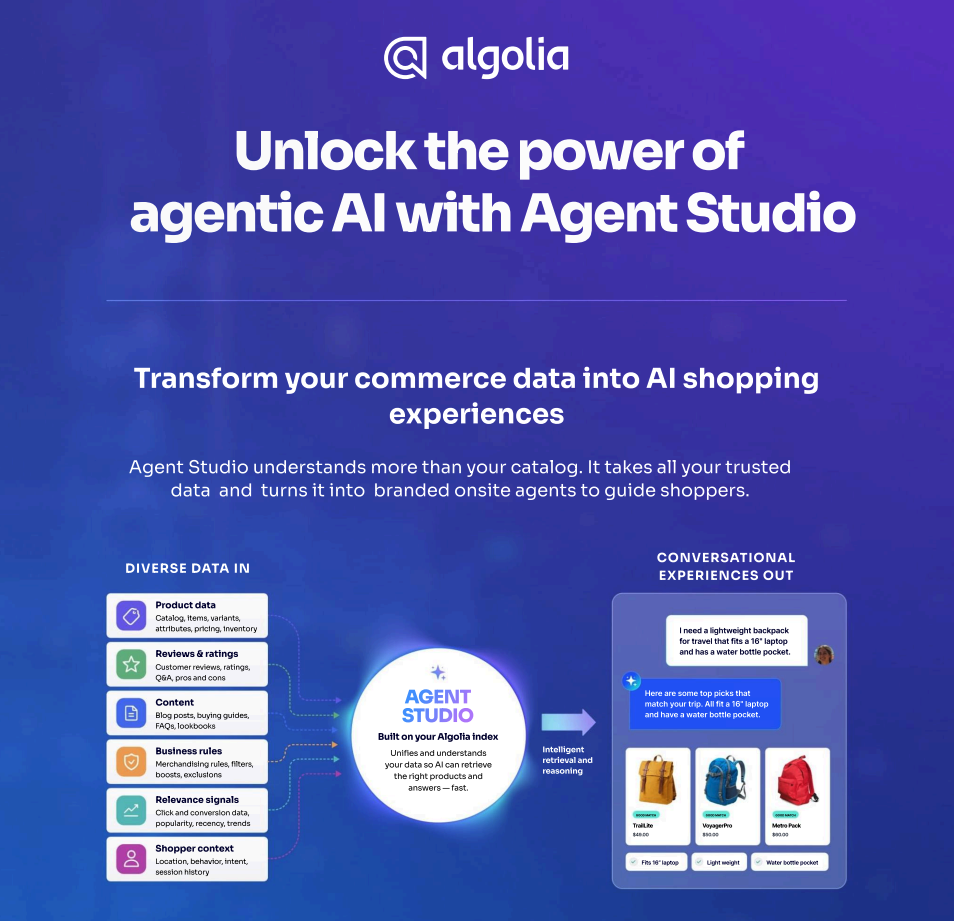
From AI-driven chatbots to AI-generated fashion designs, ecommerce businesses have countless opportunities to innovate and differentiate themselves from competitors. Virtual assistants powered by LLMs can offer customer support, answer queries in real-time, and drive sales with personalized recommendations.
Challenges and ethical considerations
While the potential benefits of AI in ecommerce are exciting, there are also risks. GenAI’s ability to produce "hallucinations" — or inaccurate content — means that businesses need to implement strict fact-checking processes to avoid misinformation. Additionally, concerns about privacy and data security are growing as AI systems handle more sensitive customer data.
The future of AI in ecommerce will depend on how businesses address these challenges and navigate the complexities of AI-driven innovation.
GenAI’s impact on the ecommerce industry
The ecommerce industry has been one of the most prominent adopters of AI technology, with genAI leading the way in transforming customer experiences and operational efficiency. Ecommerce brands are leveraging AI to personalize shopping experiences, automate processes, and optimize inventory management. In this chapter, we explore how genAI is reshaping the ecommerce landscape.
Enhanced customer experiences
One of the most notable impacts of genAI on ecommerce is its ability to enhance the customer journey. AI-generated personalized recommendations, dynamic content, and chatbots have improved engagement and conversion rates for online retailers. Features like virtual try-ons and AI-powered product customizations have also made online shopping more interactive and enjoyable.
For instance, fashion retailers can use AI to offer virtual dressing rooms where shoppers can visualize how clothes will look on them, while furniture retailers can use augmented reality (AR) to show customers how products will fit in their homes.
Increased efficiency in content creation
GenAI is drastically reducing the time and resources needed to produce high-quality marketing content. From automated product descriptions to AI-generated marketing images, ecommerce businesses are now able to scale their content production with ease. This allows marketers to focus on strategic initiatives and creative oversight, rather than spending time on repetitive tasks.
Smarter inventory management
Accurate inventory management is crucial for ecommerce businesses, and genAI is helping retailers optimize stock levels and forecast demand more accurately than ever before. AI models trained on historical sales data can predict future trends and help businesses avoid overstocking or running out of popular items, thus improving operational efficiency.
Improving ROI with AI-driven marketing
GenAI allows ecommerce businesses to personalize their marketing campaigns based on customer preferences and browsing behaviors. This leads to higher conversion rates, as customers are more likely to engage with content that resonates with them. According to a McKinsey report, businesses using AI have seen a 3-15% increase in revenue and a 10-20% improvement in sales ROI.
Conclusion: embracing the
AI-driven future
GenAI and LLMs are not only reshaping the ecommerce industry but also revolutionizing how businesses approach content creation, customer engagement, and operational efficiency. As these technologies continue to evolve, businesses that harness their potential will remain at the forefront of innovation.
Whether it's creating personalized experiences or automating routine tasks, AI offers a wealth of opportunities for growth. The future belongs to businesses that embrace this change and adapt to the new landscape of digital commerce.




.webp)


.jpg)










%20(2).svg)