Gen AI represents a structural shift in how retail platforms are built and experienced. For a long time, ecommerce systems were built around very rigid assumptions. Search worked only if customers used the right keywords. Merchandising depended on carefully maintained rules. Personalization changed slowly and was limited to a few predefined segments. This worked when product catalogs were smaller and shopping behavior was more predictable.
That is no longer how people shop.
Today, customers explain what they want in plain language. They describe scenarios and preferences instead of exact product names. They expect results to adapt quickly to their needs, even when browsing large catalogs across different channels. In comparison, static filters and keyword-driven search experiences can feel outdated and slow.
Gen AI helps retailers adapt to this shift. By understanding language, context, and intent rather than just matching words, AI-powered systems can respond more naturally. When combined with structured product data and well-designed retrieval systems, this approach allows ecommerce platforms to meet customers where they are and support the way they actually shop.
The promise of gen AI
Transforming the customer experience
Natural-language search allows customers to interact with retail platforms in a way that feels intuitive and familiar. Rather than adjusting their queries to match a platform’s specific terminology, shoppers can describe what they are looking for in plain language, including goals, preferences, and intended use. AI systems focus on understanding the intent behind these requests and return results based on meaning, not just exact wording.
Conversational shopping assistants build on this capability by offering interactive guidance throughout the shopping journey. These assistants function much like an experienced store associate, answering follow-up questions, explaining differences between products, and helping customers understand tradeoffs. By providing real-time, context-aware assistance, they reduce friction in more complex purchase decisions and help customers feel confident about their choices.
Dynamic recommendations further improve discovery by responding to what customers do in the moment. Instead of relying on static rules or fixed segments, AI-driven models adjust rankings and suggestions based on session activity and inferred preferences. This creates a discovery experience that feels more relevant and engaging, encouraging deeper exploration across the catalog.
Reinventing operational efficiency
Gen AI also delivers significant internal efficiency gains. Automated catalog population enables retailers to generate product titles, descriptions, attributes, and tags faster than before. This improves data consistency and quality while reducing manual effort across merchandising and content teams.
AI-assisted categorization and attribute extraction accelerate SKU onboarding and shorten time-to-market. Merchandising teams spend less time maintaining brittle rules and more time focusing on strategy. Support teams benefit as conversational systems handle repetitive questions related to product details, policies, and order status.
Engineering teams see reduced operational burden as relevance tuning, synonym management, and content fixes become less manual. Together, these efficiencies translate into measurable ROI through both revenue growth and cost reduction.
The risks
The same characteristics that make gen AI powerful also introduce new risks when deployed without structure.
Technical and security concerns
Generative models are probabilistic rather than deterministic. They can produce incorrect product attributes, misleading compatibility guidance, or responses that conflict with brand standards. Prompt injection and model manipulation create additional vectors for unintended behavior.
Data exposure is a central concern. Prompts, logs, and retrieval artifacts may contain sensitive signals related to customers, pricing strategies, or inventory levels if governance controls are not applied carefully. While embedding inversion attacks remain difficult in most managed production environments, organizations should still treat embeddings and retrieval data as sensitive operational assets.
Compliance and governance risks
Retailers operate under strict regulatory requirements governing data privacy and usage. Improper handling of customer data through AI systems can result in violations of regulations such as GDPR and CCPA, leading to fines, legal exposure, and reputational damage.
Uncontrolled AI deployments often force teams into reactive oversight. Inconsistent outputs, unclear accountability, and lack of auditability undermine internal confidence in the system and erode the trust required for long-term adoption.
Why this matters now
The urgency around gen AI adoption in current systems is accelerating due to changes in customer expectations and competition.
- Changing customer behavior: Consumers increasingly look for conversational search, real-time personalization, and immediate assistance. Experiences shaped by AI-native platforms have redefined what feels modern and usable in digital commerce.
- Competitive pressure among retailers: Early adopters of AI-driven discovery and personalization are achieving measurable advantages in relevance, speed, and engagement. These improvements set new expectations, forcing other retailers to modernize simply to remain competitive.
- The technology shift is structural: AI-native platforms and composable commerce architectures are redefining the baseline for retail technology. Delaying adoption risks slower merchandising cycles, higher operational costs, and long-term loss of market relevance.
Personalization and dynamic recommendations
Personalization is one of the most visible and valuable applications of generative AI in retail. Rather than treating all shoppers the same, AI-driven systems adapt discovery, ranking, and recommendations based on real-time context and historical signals. These signals may include browsing behavior, search intent, past purchases, device type, location, and session-level interactions. Together, they allow retailers to tailor experiences to individual customers without requiring manual segmentation.
Unlike traditional rule-based personalization, which relies on static segments and predefined logic, AI-driven personalization operates continuously. Rankings and recommendations adjust as a session unfolds, responding to changes in intent and engagement. Product listings, cross-sell suggestions, and promotional placements can shift dynamically, improving relevance at each touchpoint in the shopping journey. This adaptability is especially important in large catalogs, where manual tuning cannot keep pace with changing demand.
Dynamic recommendations extend beyond product carousels. AI systems influence search result ordering, category navigation, landing pages, and even conversational interactions. By embedding intelligence across these surfaces, retailers reduce friction and help customers find suitable products more quickly. From a business perspective, this directly impacts conversion rates, average order value, and repeat purchases.
Personalization also has important implications for operational efficiency and scalability. Automated ranking and recommendation models reduce the need for ongoing manual merchandising adjustments. At the same time, these systems must be designed with care, as they operate on sensitive behavioral data and often run in latency-critical paths. Effective personalization therefore sits at the intersection of ROI and responsibility, delivering measurable growth while requiring disciplined data governance and system design.
Operational efficiency and cost reduction
Gen AI automates content creation, tagging, support workflows, and relevance tuning across the retail stack. Manual maintenance declines across teams, while engineering effort shifts from upkeep to innovation.
For many organizations, operational efficiency alone justifies gen AI adoption, even before revenue gains are fully realized.
The ROI perspective: why businesses are moving fast on gen AI
Retail and ecommerce leaders face constant pressure to deliver clear, measurable growth while operating within increasingly complex technology environments. Profit margins remain narrow, customer acquisition costs continue to rise, and their expectations are changing faster than many traditional systems can keep up. In this context, gen AI is no longer treated as an experimental technology. Instead, it is increasingly seen as a practical way to improve performance and accelerate return on investment.
The business case for adopting gen AI centers on speed, scale, and operational efficiency. Unlike large platform re-architecture efforts that require long timelines and significant upfront investment, AI-driven capabilities can be rolled out incrementally and start delivering value within a relatively short period. This faster time-to-value makes gen AI especially attractive to executives who must prioritize investments that show results quickly while minimizing risk.
Where retailers see immediate ROI
The most immediate ROI from gen AI appears in customer-facing discovery and engagement flows. Improvements in search relevance alone can materially increase conversion rates, as search-driven sessions often represent high-intent traffic. Even small gains in relevance translate directly into revenue uplift at scale.
Personalization further amplifies this impact. By adapting rankings, recommendations, and promotions in real time, AI-driven systems increase average order value and repeat purchase rates. These gains compound over time, strengthening customer lifetime value rather than delivering one-time benefits.
Catalog intelligence delivers ROI through both revenue and cost reduction. Cleaner product data improves discoverability and SEO performance, while automated enrichment reduces manual effort across merchandising and content teams. Faster onboarding of new products allows retailers to capitalize on trends and supplier opportunities more quickly.
Customer support is another area of near-term impact. Conversational assistants reduce ticket volume by handling repetitive inquiries related to products, policies, and order status. This lowers support costs while improving response times and customer satisfaction.
Time-to-value as a strategic metric
For business leaders, time-to-value often matters more than theoretical long-term upside. gen AI adoption is attractive precisely because it can deliver measurable outcomes without requiring multi-year transformation programs.
Managed AI platforms and APIs allow teams to deploy advanced capabilities without building and maintaining complex infrastructure from scratch. This reduces upfront investment, shortens implementation timelines, and lowers execution risk. In many cases, teams can launch pilots within weeks and scale successful use cases incrementally.
Faster time-to-value also reduces organizational friction. When stakeholders see early wins, adoption accelerates organically across teams. This momentum is difficult to achieve with traditional enterprise initiatives that delay benefits until late in the project lifecycle.
Cost reduction and margin expansion
Return on investment is not driven by revenue growth alone. Gen AI also enables meaningful cost savings across several parts of the organization.
Automation reduces the amount of manual work involved in content creation, tagging, and ongoing catalog maintenance. Support teams spend less time handling repetitive questions, while engineering teams devote fewer hours to tuning relevance rules, managing synonyms, or correcting data issues. Together, these efficiencies directly contribute to healthier operating margins.
AI-driven systems also help reduce less visible costs tied to poor discovery experiences. When customers are shown irrelevant products or unclear descriptions, return rates tend to rise, bringing higher fulfillment and logistics expenses. More accurate product matching lowers these downstream costs by helping customers make better purchase decisions upfront.
Over time, these improvements lead to a more scalable operating model. Retailers can support growth without needing to increase headcount or overhead at the same pace, strengthening long-term efficiency and resilience.
ROI and risk are interconnected
While the potential upside is significant, ROI cannot be assessed without considering risk. Security incidents, compliance failures, or loss of customer trust can quickly offset any financial gains generated by AI-driven initiatives.
A single data exposure can lead to regulatory penalties, legal costs, remediation work, and lasting damage to a brand’s reputation. Even issues that are less visible, such as inconsistent AI responses or incorrect product information, can weaken customer confidence and drive up support costs.
From a business standpoint, unmanaged risk effectively becomes negative ROI. Addressing problems after systems are already in production is almost always more expensive and disruptive than preventing them through careful design, governance, and architectural discipline.
Why security enables sustainable ROI
Security should not be seen as something that slows innovation down. When it is built in thoughtfully, it actually makes scaling AI capabilities with confidence and speed easier.
Clear data boundaries give teams the freedom to experiment without worrying about accidental data exposure. Well-defined access controls and governance frameworks reduce internal friction by making it clear what is allowed and where limits exist. When systems behave in predictable ways, stakeholders develop trust, which helps AI adoption spread more quickly across the organization.
Retailers that invest early in secure architectures are better positioned to expand their use of AI over time. They spend less effort dealing with incidents or corrective work and more time improving performance and customer experience. Over the long term, this stability supports stronger and more sustainable ROI.
Aligning business and engineering incentives
One of the biggest barriers to realizing ROI from gen AI is the disconnect between business priorities and engineering constraints. Business leaders tend to focus on speed, conversion, and revenue impact, while engineering teams are accountable for system reliability, safety, and predictable behavior.
Organizations that succeed are able to align these perspectives. They frame security and architectural choices in ways that clearly support business outcomes. Latency targets are treated as safeguards for revenue rather than purely technical metrics. Data governance is recognized as essential for scaling personalization safely. Reliability becomes a core driver of customer trust and long-term retention.
When both business and engineering teams share a clear understanding of these tradeoffs, decisions are made more quickly and the results are more consistent.
Security risks introduced by gen AI in retail and ecommerce
Gen AI introduces a fundamentally different risk profile than traditional retail systems. Conventional ecommerce platforms process structured inputs through predictable, rule-based logic. Gen AI systems, by contrast, operate on probabilistic models, interpret natural language, and rely on large data representations such as embeddings. This shift expands both the attack surface and the range of potential failure modes.
Many of these risks are slow to surface at the beginning. Instead of causing obvious outages or clear security incidents, issues often emerge gradually through unintended data exposure, inaccurate outputs, or unexpected system behavior. By the time such problems are identified, customer trust and regulatory standing may already be compromised.
Gaining a clear understanding of this risk landscape is critical. Without it, organizations struggle to put effective controls in place while continuing to innovate at the pace the business demands.
Data exposure and leakage risks
Retail ecosystems handle some of the most sensitive data found in any consumer-facing industry. Customer personal information, behavioral data, product intelligence, internal operational details, and pricing strategies all represent high-value assets. When gen AI systems are introduced, this data often flows through new processing layers that were not originally designed with retail compliance and privacy requirements in mind.
Because large language models work directly with text, sensitive information can unintentionally appear in prompts, logs, cached inference data, or retrieval artifacts if inputs and storage policies are not tightly controlled. If inputs are not tightly controlled, customer information may be stored longer than expected or resurface later in ways that are difficult to predict.
Additional risk arises when internal data is used for fine-tuning or continuous learning. Proprietary pricing rules, supplier terms, or unique catalog attributes may influence model behavior or downstream retrieval systems if data boundaries are not managed carefully. Once this happens, detecting and removing that information is extremely difficult and, in many cases, impractical.
Shared or multi-tenant inference environments introduce another layer of concern. Without strong isolation mechanisms– queries, retrieval artifacts, or improperly isolated AI workflow data may create cross-tenant exposure risks. For retailers operating at scale, even rare incidents of this kind can have serious and unacceptable consequences.
Hallucinations and uncontrolled output
Unlike deterministic systems, gen AI produces outputs based on probability rather than fixed rules. This flexibility enables more natural and conversational interactions, but it also introduces a level of unpredictability that must be carefully managed.
In a retail setting, hallucinations can appear in several ways. A model might generate incorrect product attributes, provide misleading compatibility advice, or state policies that are not actually supported. In some cases, the system may present assumptions or inferred details as facts, even when that information does not exist in the underlying data.
From the customer’s point of view, the cause of the mistake does not matter. An incorrect answer is experienced as a failure of the brand itself. Misleading claims can create legal exposure, while inaccurate recommendations often lead to higher return rates and increased demand on support teams.
These issues also affect internal confidence. When AI outputs are inconsistent or difficult to justify, merchandising and customer experience teams may hesitate to rely on them. Without clear guardrails and controls, hallucinations become a systemic risk rather than a simple quality concern.
Prompt injection and model manipulation
Gen AI systems are particularly susceptible to prompt injection attacks. In these situations, attackers use carefully constructed inputs to bypass system instructions, extract sensitive information, or influence how the system behaves.
These attacks may attempt to make a model ignore safety rules, reveal internal prompts, or expose details about underlying data structures. When gen AI systems are connected to backend services such as pricing APIs, inventory platforms, or loyalty programs, the risk extends beyond information leakage. In these cases, prompt injection can directly affect business operations. Modern conversational AI systems introduce additional risks when models are connected to tools, workflows, or external services. Attackers may attempt to manipulate agents into triggering unauthorized actions, accessing restricted capabilities, or interacting with systems beyond their intended scope. As AI workflows become more agent-oriented, security increasingly depends on controls such as tool whitelisting, scoped permissions, action sandboxing, and explicit approval boundaries for sensitive operations.
Without strong policy enforcement and proper sandboxing, manipulated prompts can result in unauthorized data exposure, incorrect pricing being displayed, or distorted recommendations. Because large language models do not follow fixed rules in the same way as traditional software, standard input validation alone is not enough to prevent these types of attacks.
Latency tradeoffs introduced by safety layers
Retail experiences are extremely sensitive to performance. Search speed has a direct effect on engagement, conversion rates, and revenue, and even small increases in latency can reduce click-through rates and shorten user sessions.
At the same time, production-grade gen AI systems rely on multiple safety mechanisms. These often include content filtering, compliance checks, personal data scrubbing, policy enforcement layers, secure request routing, and multi-step retrieval workflows. Each of these protections adds some amount of processing time to the overall request.
The real challenge is not deciding whether safety measures are necessary, but designing them in a way that does not degrade the user experience. If response times slow down too much, the revenue benefits promised by gen AI can quickly disappear.
This creates a critical engineering tradeoff. Stronger safety controls introduce additional overhead, while increased latency directly affects conversion. To balance these forces, retailers must design systems that apply protection efficiently, using techniques such as pre-filtering, caching, and selective enforcement rather than applying every safeguard to every request.
Expanded attack surface
Adding gen AI to a retail technology stack increases overall system complexity. Components such as vector databases, embedding pipelines, orchestration layers, external inference services, and safety filters all become part of the production environment.
Each additional component introduces new credentials to manage, new network paths, and new configuration surfaces. In reality, many security incidents are not caused by sophisticated attacks but by simple misconfigurations, such as unsecured endpoints, overly broad access permissions, or exposed logs.
Gen AI systems increase the number of places where these types of errors can occur. Without strong automation and clear governance, the operational workload for security and DevOps teams can grow quickly and become difficult to manage.
Compliance and governance challenges
Retailers operate within strict regulatory environments that govern how customer data is collected, processed, and stored. Gen AI adds complexity to compliance because it changes how data moves through systems and how long information may persist across different layers.
Regulations such as GDPR and CCPA require organizations to minimize data usage, provide transparency into how data is accessed, and support the deletion of personal information when required. AI systems must be designed to meet these obligations not only at the data source, but also across prompts, embeddings, logs, and generated responses.
Governance requirements go beyond regulatory compliance. Organizations also need clear audit trails, the ability to explain AI-driven decisions, and internal controls that align with existing risk and oversight frameworks. Without these foundations, AI deployments become fragile and difficult to expand safely.
Compliance failures can be expensive and disruptive. Even when revenue and performance metrics look strong, regulatory penalties or forced shutdowns can quickly undo progress. Governance should not be seen as an obstacle to innovation. It is a necessary condition for deploying AI responsibly and at scale.
Architecture patterns that balance security and ROI
Retail leaders often assume that stronger security will slow systems down and delay the delivery of value. In practice, the opposite is often true when security is built into the architecture from the beginning rather than added after deployment. Well-designed gen AI architectures integrate protection directly into data flows, access boundaries, and execution paths, which helps reduce risk while maintaining low latency and operational efficiency.
The objective is not to restrict systems as much as possible, but to control exposure carefully. Each system should surface only the data and capabilities required to deliver value, and nothing more. This principle forms the foundation for the architectural patterns discussed in this section.
Secure retrieval over model training
One of the most important architectural choices when adopting gen AI is deciding how proprietary data should be used. Teams must choose between embedding sensitive information directly into models through fine-tuning or retrieving that information dynamically when a request is made.
Secure retrieval approaches, commonly known as retrieval-augmented generation, keep sensitive data outside the model itself. Product catalogs, pricing details, policies, and customer-facing content remain stored in controlled databases or search indexes. When a query is processed, only the specific information needed to answer that request is retrieved and provided to the model.
This design significantly reduces the risk of data being memorized or unintentionally exposed by the model. It also makes compliance easier to manage, since data can be updated or removed without retraining. From a return on investment perspective, retrieval-based systems tend to be faster to launch, less expensive to maintain, and simpler to audit over time.
Data minimization and boundary enforcement
Gen AI systems should be designed around the principle of limiting data exposure. Prompts should include only the information needed to answer a specific request, and personal data should be excluded whenever possible or replaced with anonymized signals.
Strong boundary enforcement helps keep different types of data separate. Customer data, product catalog information, and internal operational data should not be combined without clear justification. These boundaries are most effective when enforced through access controls and scoped credentials at the infrastructure level, rather than relying only on application logic.
Reducing the volume of sensitive data that flows through AI systems lowers overall risk and often improves performance at the same time. Smaller prompts and cleaner context reduce processing overhead, which leads to faster responses and lower model-related costs.
Build vs buy: operational reality
When adopting generative AI, retailers must decide whether to build capabilities internally or rely on managed platforms. This decision has direct impact for both return on investment and security posture, and it extends far beyond questions of technical feasibility.
Building in-house provides maximum control and flexibility, but it also requires a substantial and ongoing commitment. Teams must design and operate embedding pipelines, manage vector storage infrastructure, build orchestration layers, and implement safety mechanisms such as input validation, output moderation, and policy enforcement. In addition to initial development, internal teams assume responsibility for monitoring, incident response, on-call coverage, and continuous updates as models, data, and regulatory requirements evolve. Security ownership in this model is absolute, and any gaps or failures fall entirely on the organization.
Managed platforms offer a different tradeoff. By providing production-ready infrastructure, established security practices, and operational tooling, these platforms significantly reduce time-to-value. Capabilities such as access control, monitoring, and compliance support are available out of the box and benefit from sustained investment and economies of scale that are difficult for individual retailers to replicate. Operational responsibility is shared, allowing internal teams to focus more on differentiation and optimization rather than maintaining foundational systems.
From a return on investment perspective, buying often accelerates deployment and lowers long-term operational overhead. Teams can launch, measure impact, and iterate within weeks or months instead of committing to multi-year build efforts. From a security standpoint, mature platforms typically offer stronger default protections, clearer compliance posture, and more predictable behavior under load.
The strategic question is not whether building is possible, but whether it creates meaningful competitive differentiation. For most retailers, ownership of infrastructure does not equate to advantage. In cases where AI capabilities are not core intellectual property, adopting managed platforms often delivers faster, safer, and more sustainable ROI.
Risk ownership and time-to-value comparison
The build versus buy decision directly determines who owns risk and how quickly value can be realized.
What internal teams must own when building in-house
- Design and operation of embedding pipelines and vector infrastructure
- Security controls for prompts, retrieval, and model outputs
- Monitoring, logging, and incident response across AI systems
- On-call coverage and operational support for production workloads
- Compliance management, audits, and remediation
- Continuous updates as models, data, and regulations evolve
What managed platforms typically absorb
- Production-ready infrastructure and scaling mechanisms
- Built-in access control, isolation, and security defaults
- Observability tooling and operational monitoring
- Ongoing security hardening and compliance support
- Reliability engineering and incident mitigation
- Platform-level optimizations that reduce operational overhead
Impact on time-to-value and ROI
- Managed platforms enable faster deployment and earlier ROI realization
- Reduced operational burden lowers long-term cost and risk exposure
- Internal teams focus on differentiation rather than foundational systems
- Faster iteration cycles accelerate learning and value compounding
Tenant isolation and access control
Multi-tenant retail systems need strong isolation to ensure that data from one tenant cannot be accessed by another. This requirement applies not only to structured data, but also to AI-related artifacts such as embeddings, logs, and intermediate outputs.
Tenant isolation is typically enforced through scoped retrieval patterns that combine secured API keys, filter constraints, and index-level separation where appropriate. In large-scale retail search systems, approaches such as filtered retrieval and virtual replicas help enforce tenant and relevance boundaries without duplicating infrastructure unnecessarily. Access should be restricted through narrowly scoped credentials and per-record permissions rather than shared keys or broad administrative access.
Clear isolation reduces security risk and also makes systems easier to operate. It simplifies debugging, supports compliance audits, and allows teams to understand data boundaries with confidence. With proper isolation in place, retailers can experiment and scale AI capabilities across tenants more safely.
Guardrails at the right layers
Effective guardrails work best when they are layered and applied with intent. Input validation, output moderation, and policy enforcement should be placed at the points in the request flow where they are most relevant, rather than combined into a single, catch-all filter.
For example, personal data can be removed or masked before retrieval takes place. Content moderation can be applied selectively to generated responses, and policy enforcement can be scoped to specific endpoints or use cases instead of being applied across the entire system.
This targeted approach reduces unnecessary processing while still providing strong protection. Individual guardrails can be updated or adjusted independently as requirements evolve, making the system easy to maintain.
Input filtering and output moderation in practice
Effective guardrails depend on applying controls at the right stages of the request lifecycle rather than relying on a single, global filter.
Pre-retrieval scrubbing
- Inspect inputs before search, retrieval, or model invocation
- Remove or mask personal data, credentials, and prohibited content
- Prevent sensitive information from entering prompts, logs, or embeddings
- Reduce downstream exposure and compliance risk early in the pipeline
Post-generation moderation
- Evaluate model outputs before returning responses to users
- Check for factual accuracy, policy compliance, and brand safety
- Validate product claims, policy statements, and recommendations
- Adjust, truncate, or block responses that violate defined rules
Allow, deny, and fallback behavior
- Allow safe responses to pass through unchanged
- Deny responses that violate security, compliance, or brand policies
- Define fallback responses such as generic guidance or escalation paths
- Ensure predictable system behavior during edge cases
Conditional invocation strategies
- Apply lightweight checks to low-risk flows such as structured search
- Trigger deeper moderation for high-risk or free-form interactions
- Avoid unnecessary processing for latency-sensitive requests
- Balance protection and performance through context-aware enforcement
Latency-aware safety design
In retail and ecommerce, latency is not an abstract technical concern. It is a direct driver of engagement, conversion, and revenue. Search, typeahead, and discovery interactions operate under tight performance budgets. Any security or safety mechanism introduced into these paths must be designed with this constraint in mind.
Not all safety checks belong in real-time execution paths. High-frequency interactions such as query parsing, retrieval, ranking, and filtering must remain lightweight and predictable. Deterministic checks, such as access control enforcement, tenant isolation, attribute filtering, and pre-defined business rules, are well suited for inline execution because they are fast and easy to reason about. These controls form the foundation of safe real-time systems.
Other mechanisms can be optimised without compromising protection. Content moderation of generated responses, deeper policy analysis, anomaly detection, and audit logging can often occur asynchronously or conditionally. When safety checks in real-time paths are kept lightweight and deeper analysis is handled elsewhere, retailers can protect performance without compromising oversight.
Caching and pre-filtering are essential to striking the right balance between safety and performance. Filtering records before semantic processing and caching frequently accessed results help minimize redundant work and reduce repeated safety checks. Together, these techniques lower infrastructure costs while delivering faster, more consistent responses.
In practice, low-latency retail systems rely on deterministic controls that execute directly in the retrieval path. This includes retrieval-time filters, scoped API keys that enforce tenant and capability boundaries, and precomputed relevance rules that run before any generative processing occurs. Platforms such as Algolia document this approach explicitly, emphasizing that authorization, filtering, and ranking decisions must execute within the core search engine rather than as downstream moderation steps, preserving millisecond-level response times even under heavy load. These patterns are reflected in published guidance on secured API keys, filter-based access control, and hybrid retrieval architectures referenced in this brief.
Applying the same level of moderation to every interaction is rarely effective. Uniformly enforcing heavy safety checks across all requests increases processing overhead and can degrade user experience without delivering a corresponding reduction in risk. Retail interactions differ widely in sensitivity. A structured product search carries a very different risk profile than an open-ended customer support conversation. Safety controls should therefore be applied selectively, based on context, data sensitivity, and potential impact.
Effective systems treat safety as a targeted mechanism rather than a blanket cost applied to every request. By aligning protection measures with both latency constraints and risk profiles, retailers can maintain the performance advantages of AI-driven experiences while still enforcing robust safeguards. This approach avoids a false choice between security and conversion and allows both to improve in tandem.
Secure model gateways and policy enforcement
As generative AI systems become integrated into customer-facing retail workflows, direct access to models introduces unnecessary risk. Secure architectures place a model gateway (in dark blue, Fig:2) between applications and AI services to centralize control, enforcement, and observability. This gateway becomes the primary entry point for all model interactions.
Centralizing request handling ensures that all prompts and responses are evaluated through a single, consistent enforcement layer. Rather than scattering security logic across multiple services, policies are applied once at the gateway, reducing duplication, minimizing configuration drift, and making the system easier to maintain as it evolves.
Authentication and authorization are handled at this boundary instead of within individual applications. Each request is validated against identity, tenant context, environment, and permitted actions before a model is invoked. Scoped credentials and policy checks ensure that access to sensitive data is tightly controlled and that every request operates within clearly defined limits. In agent-oriented systems, gateways also help enforce execution boundaries around tools and downstream actions. Permissions can be scoped to approved capabilities, while sensitive operations are isolated through sandboxing and explicit policy enforcement layers. These controls reduce the risk of conversational agents triggering unintended actions or interacting with systems outside their authorized scope.
By centralizing model access behind a secure gateway, retailers reduce blast radius during model or provider changes, since swapping inference backends or introducing new models does not require changes to application logic or direct access to downstream systems. Security teams gain a single, auditable control plane where policies can be updated or tightened without redeploying applications. Critically, this approach separates AI policy enforcement from application logic. Product and engineering teams can focus on building user experiences without re-implementing security controls in every service. Security teams gain a single, auditable control plane where policies can be updated or tightened without redeploying applications.
By introducing a secure model gateway, retailers reduce risk while improving operational clarity. Centralized enforcement enables safer experimentation, faster iteration, and more predictable behavior as AI usage expands across the platform.
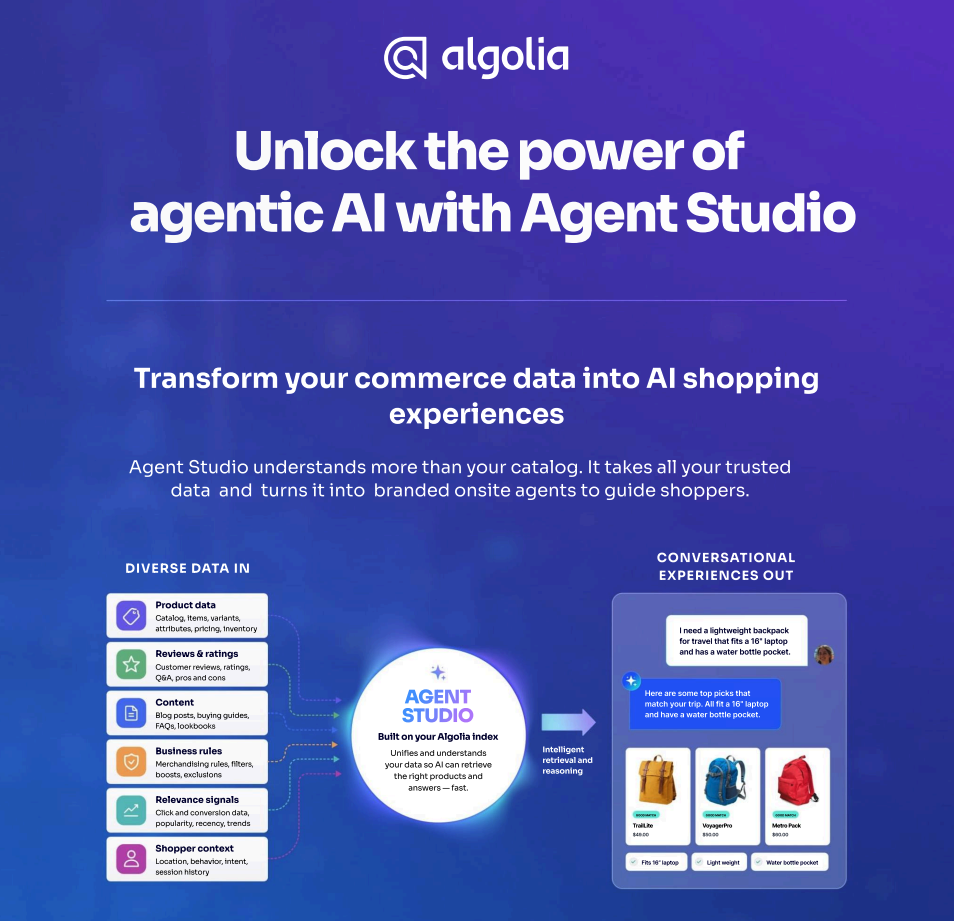
Platforms such as Algolia Agent Studio reflect this architectural approach by providing centralized orchestration, retrieval control, and policy enforcement for AI-driven interactions. Rather than embedding security logic independently across applications, teams can define governed workflows, scoped retrieval behavior, and controlled access patterns through a unified operational layer. This helps reduce configuration drift while improving observability and consistency across customer-facing AI experiences.
Decision frameworks for balancing security and ROI
The financial impact of generative AI in retail is not evenly distributed across workflows. Some use cases deliver immediate and measurable ROI, while also carrying higher security, privacy, and performance risk. Understanding where these forces intersect is essential for prioritizing adoption and designing systems that scale safely.
Search, catalog intelligence, and personalization consistently sit at the center of this intersection. These workflows directly influence revenue, customer trust, and operational efficiency, but they also operate under strict latency constraints and involve sensitive, customer-facing data. As a result, they require more deliberate architectural and governance decisions than lower-risk internal use cases.
Search and discovery
Search and discovery represent some of the highest-intent interactions in retail. Customers who actively search are often closer to purchase, which means even small improvements in relevance can translate directly into higher conversion rates and revenue. Generative AI improves this experience by interpreting intent, context, and semantics rather than relying solely on exact keyword matching.
At the same time, search is one of the most latency-sensitive workflows in the retail stack. Features such as typeahead and search-as-you-type operate within tight performance budgets, where even small delays can reduce engagement. Search queries may also include personal data or sensitive intent signals, making search a critical surface for both performance and security risk.
Real-time search systems work best when security and relevance controls are integrated directly into retrieval and ranking flows, preserving both speed and data boundaries. For example, search and discovery systems such as Algolia apply access control, filtering rules, and tenant isolation directly at retrieval time, allowing relevance improvements to coexist with low latency and clear data boundaries.
As AI-driven discovery experiences become more conversational and workflow-oriented, orchestration layers also play a growing role in balancing relevance, governance, and operational consistency. Platforms such as Algolia Agent Studio illustrate how retailers can coordinate retrieval, ranking, and AI interactions through governed workflows rather than exposing models directly to downstream systems. This approach helps teams scale conversational discovery while maintaining clearer control over latency, access boundaries, and policy enforcement.
Catalog intelligence and merchandising
Catalog intelligence delivers ROI through both revenue growth and cost reduction. Automated enrichment of product titles, descriptions, attributes, and tags improves discoverability and SEO performance while reducing manual effort across merchandising and content teams. Faster enrichment also shortens supplier onboarding cycles, allowing retailers to respond more quickly to trends and seasonal demand.
Because enrichment pipelines often process large volumes of product data, they introduce meaningful data exposure risk. Catalogs may contain proprietary pricing logic, internal notes, or unreleased items alongside customer-facing attributes. If these signals are not carefully isolated, they can surface unintentionally in generated content or be retained in downstream systems.
This makes index boundaries and retrieval scope critical. Retail platforms that separate public catalog attributes from internal operational metadata reduce the blast radius of enrichment workflows. In practice, catalog systems built on structured search indices, such as those used by platforms like Algolia, demonstrate how clearly defined schemas and access rules can support large-scale enrichment without exposing internal data beyond its intended audience. By enforcing strict boundaries between enrichment inputs and published outputs, retailers can scale catalog automation confidently while maintaining compliance and protecting intellectual property.
Personalization and recommendations
Personalization is among the highest-ROI applications of AI in retail, but it also involves some of the most sensitive data. Behavioral signals such as browsing activity, purchase history, and inferred preferences enable more relevant recommendations, yet they require careful handling to preserve privacy and trust.
Personalization systems often operate in real time, adapting rankings and recommendations within a single session. This places additional constraints on latency and system design. Security and privacy controls must be enforced without disrupting responsiveness, especially on high-traffic surfaces such as homepages, category pages, and search results.
In practice, effective personalization systems rely on scoped data access and anonymized signals rather than raw personal information. Recommendation pipelines that integrate directly with retrieval and ranking layers, similar to approaches used in real-time personalization systems like Algolia’s ranking and filtering infrastructure, show how relevance can be adjusted per user context without broad exposure of sensitive data.
Governance remains essential at scale. Teams must define which behavioral signals are permitted, how long they can be retained, and how recommendation decisions can be audited or explained. When these rules are enforced consistently at the system level, personalization can expand across channels and regions while maintaining compliance and customer trust.
Operational constraints in real-time personalization
Real-time personalization systems must balance customer relevance, data sensitivity, and performance constraints.
Behavioral data sensitivity
- Uses signals such as clicks, browsing history, and purchase behavior
- May include inferred preferences and intent
- Requires strict data minimization and scoped usage
- Personal data should not be unnecessarily exposed in prompts or logs
Latency requirements
- Must operate within tight performance budgets
- Runs in high-frequency paths such as search and discovery
- Limits model complexity and safety checks in the critical path
- Favors precomputed features and lightweight inference
Governance implications
- Requires clear rules on which data can be used for personalization
- Enforces access control and retention policies
- Supports auditability and regulatory compliance
- Prevents unintended reuse or overreach of behavioral data
Typical system flow
- Preprocess behavioral signals outside the request path
- Apply scoped, real-time context at query time
- Generate personalized ranking or recommendations quickly
- Log decisions for monitoring and governance without exposing sensitive data
Engineering practices that enable secure ROI
In many organizations, security is still treated as a cost or a barrier to innovation. This mindset becomes even more common when adopting gen AI, where teams often emphasize speed and experimentation. In practice, however, security plays a different role in AI-driven retail environments. It increasingly serves as a source of competitive advantage rather than just a defensive requirement.
As AI becomes more deeply embedded in customer-facing experiences, trust becomes a central part of brand value. Retailers that can clearly demonstrate responsible AI use, strong data protection, and regulatory compliance are better positioned to earn and maintain customer confidence. That trust, in turn, influences adoption, engagement, and long-term revenue growth.
Observability and monitoring
Secure systems must be observable in production. Without visibility, teams cannot detect misuse, understand performance regressions, or respond quickly to incidents.
Effective observability focuses on four signal categories:
- Relevance
- Search result engagement
- Click-through rates
- Query reformulation frequency
- Zero-result or low-quality result patterns
- Latency
- End-to-end request time
- Retrieval and ranking latency
- Tail latency under load
- Performance impact of safety layers
- Safety and misuse
- Unexpected query patterns
- Access attempts outside expected scopes
- Sudden changes in attribute access
- Repeated policy-triggered responses
- Incidents and reliability
- Error rates
- Partial outages or degradation
- Rollbacks or configuration changes
- Time to detection and resolution
Observability data should be reviewed continuously, not only during incidents. When teams can correlate relevance, latency, and safety signals, they can optimize systems without introducing new risk.
Measuring technical ROI
Technical ROI is a leading indicator of business ROI. Engineering teams should track signals that show whether systems are becoming easier to operate, safer to scale, and faster to improve.
Key indicators include:
- Reduced incidents
- Fewer production outages and regressions
- Lower frequency of security-related escalations
- Reduced time spent on emergency fixes and rollbacks
- Improved system stability as guardrails mature
- Less manual tuning
- Decreased reliance on hand-crafted relevance rules
- Fewer manual synonym updates and ranking overrides
- Reduced need for ad hoc data corrections
- Increased confidence in automated optimization
- Faster iteration
- Shorter deployment and experimentation timelines
- Faster feedback loops from real user behavior
- Easier rollback and refinement of changes
- Improved collaboration across product, engineering, and security teams
When these metrics improve, engineering effort shifts from maintenance to optimization. Over time, this compounds ROI by lowering operational cost, improving system stability, and enabling faster delivery of customer-facing improvements.
Access control and tenancy isolation
Strong access control is foundational to secure AI systems, especially in multi-tenant retail environments. Without clear boundaries, even well-intentioned systems can expose data across customers, brands, or regions.
Key practices include:
- API key scoping
- Use narrowly scoped keys rather than broad, shared credentials
- Restrict keys by index, operation type, and allowed filters
- Apply short-lived keys for client-side usage when possible
- Per-record and attribute-level permissions
- Enforce which records a request is allowed to access
- Limit which attributes are retrievable in different contexts
- Separate public-facing fields from internal or operational metadata
- Tenant isolation by design
- Encode tenant boundaries directly into retrieval and filtering logic
- Avoid relying on application-layer checks alone
- Prefer infrastructure-enforced isolation that is auditable and predictable
- Avoiding shared credentials
- Eliminate shared admin or service keys across environments
- Separate credentials by service, tenant, and environment
- Rotate keys regularly and monitor usage patterns
Search platforms such as Algolia demonstrate how scoped API keys and filter-based isolation can enforce tenant boundaries efficiently within high-scale environments.
The future of ROI in AI-driven retail and ecommerce
Gen AI is doing more than refining existing retail workflows. It is changing how value is created, delivered, and sustained across the entire retail ecosystem. As these capabilities mature, return on investment will depend less on isolated features and more on how deeply intelligence is built into core platforms and everyday operations.
Retailers that design with adaptability, automation, and trust in mind from the beginning will be best positioned to capture long-term value. These foundations allow AI to scale naturally as customer expectations and technology continue to evolve.
AI-native retail platforms
Early AI adoption in retail often delivers considerable wins through features like chatbot search, automated content generation, or basic personalization. These initial successes are typically lightweight and easy to deploy, which can create the impression that AI is primarily an add-on capability. Over time, it becomes evident that AI is deeply embedded into core systems that drive discovery, pricing, merchandising, and customer interaction. As these capabilities move from experimentation into mission-critical infrastructure, the cost of failure increases significantly. Governance, observability, and security controls that may have been optional during early pilots become mandatory to ensure stability, compliance, and trust at scale.
Composable commerce and modular AI
Composable commerce architectures are reshaping how retailers assemble technology stacks. Instead of relying on monolithic platforms, organizations increasingly combine best-in-class services through APIs.
AI fits naturally into this model. Search, personalization, catalog intelligence, fraud detection, and support automation can be deployed as modular components. Retailers can adopt AI capabilities incrementally, validate ROI, and replace components as needs evolve.
This modularity reduces vendor lock-in and lowers experimentation risk. Teams can test new capabilities without committing to large-scale rewrites. Successful components can be scaled quickly, while underperforming ones can be replaced.
Composable architectures also support better security boundaries. Each service operates within a defined scope, reducing blast radius and simplifying governance.
Security as a long-term differentiator
As AI becomes pervasive, security and trust will increasingly differentiate platforms. Customers, partners, and regulators will expect clear evidence that AI systems are governed responsibly.
Certifications, auditability, data protection practices, and transparent AI behavior will influence purchasing decisions and partnerships. Retailers that demonstrate strong security posture will be better positioned to adopt advanced AI use cases that require deeper data access.
From an ROI standpoint, trust unlocks opportunity. Secure systems allow retailers to leverage richer signals, deploy more personalized experiences, and expand AI usage across markets without repeated friction.
The economics of automation at scale
Automation powered by gen AI is reshaping the cost structure of retail operations. Work that once required proportional increases in headcount can now scale through data and compute instead.
Areas such as catalog management, content creation, customer support, and relevance tuning become more automated over time. As a result, the incremental cost of supporting additional products, customers, or interactions continues to decrease.
This shift benefits retailers that invest early in scalable AI foundations. Over time, these organizations are able to grow faster than competitors without matching increases in operational expense, leading to stronger margins and greater long-term resilience.
Preparing for continuous change
AI technologies will continue to evolve rapidly as new models, architectures, and regulatory requirements emerge. To succeed, organizations will need to prioritize flexibility. Investing in modular architectures, clear governance, and strong observability would prove to be beneficial. These foundations allow teams to incorporate new AI capabilities without destabilizing existing systems.
Strategic implications for retail leaders
For executives and product leaders, the future of AI-driven retail demands a shift in mindset. AI adoption is no longer a discrete project. It is an ongoing capability that must be managed strategically.
Leaders must evaluate investments based on long-term scalability, security posture, and organizational readiness rather than short-term feature delivery alone. Those who succeed will treat AI as core infrastructure rather than experimental tooling.
Bringing security and ROI together: conclusion and practical takeaways
Gen AI is no longer an emerging capability in retail and ecommerce. It is becoming a foundational component of how customers discover products, make decisions, and interact with brands. The question facing retailers today is not whether to adopt AI, but how to do so in a way that delivers measurable ROI without introducing unacceptable risk.
This whitepaper has shown that security and ROI are deeply interconnected. Fast, poorly governed AI deployments may generate short-term gains, but they often introduce long-term liabilities that erode value. Conversely, overly restrictive approaches slow innovation and delay competitiveness. Sustainable success lies in balancing these forces through disciplined architecture, clear governance, and aligned incentives.
Key lessons for retail leaders
Product leaders and executives will have to prepare for constant emerging themes. Enhancements in search relevance, personalization, catalog accuracy, and operational efficiency drive direct improvements in revenue and cost structure, with value that compounds over time rather than fading after initial gains.
Poorly managed tasks like data leaks, unreliable outputs, regulatory issues, and performance slowdowns can undo progress and become a drag on returns. Designing systems to prevent these issues from the start is far less costly than correcting them after deployment.
Speed is essential for impact. Retailers that rely on modular, managed, and retrieval-based AI architectures tend to move faster and with greater confidence than those attempting to build and secure every component themselves without sufficient safeguards.
Key lessons for engineering and security teams
From an engineering standpoint, architecture plays a decisive role in determining outcomes. Choices around data boundaries, retrieval methods, access controls, and latency limits directly affect both system safety and overall business performance.
Security is most effective when it is built into system design from the start rather than added later. Using retrieval-based approaches minimizes data exposure by avoiding model-side data storage, while scoped access and tenant isolation support clearer compliance boundaries. Effective observability provides early insight into production behavior, enabling teams to respond proactively and prevent escalation.
Organizational alignment as a force multiplier
One of the strongest indicators of successful AI adoption is alignment across teams. When business leaders, engineers, security teams, and legal stakeholders work from a shared framework, decisions are made more quickly and with greater consistency.
Describing security tradeoffs in terms of ROI helps close gaps between these groups. Latency targets are understood as a way to protect revenue. Governance is seen as something that enables scale rather than blocks progress. Reliability becomes a foundation for customer trust and long-term retention.
Organizations that achieve this level of alignment are better equipped to scale AI responsibly and with confidence.
A practical path forward
Retailers aiming to balance security and ROI should concentrate on a small set of practical actions.
Begin with high-impact and visible use cases such as search and product discovery, where ROI is easier to measure and communicate. Retrieval-based architectures can reduce data exposure and make compliance easier to manage. Retailers should choose modular platforms that support incremental rollout and safe experimentation.
Clear governance should be established early. Define data boundaries, access controls, and audit processes before expanding usage. Invest in observability so teams can continuously monitor both system performance and risk as AI capabilities scale.
Measure success holistically. Track revenue and conversion metrics alongside security incidents, compliance findings, and operational stability. This balanced view ensures that short-term gains do not mask long-term liabilities.
Conclusion
As AI becomes a core part of retail platforms, the ability to scale it responsibly will increasingly separate market leaders from those that fall behind. Trust, system reliability, and regulatory readiness will play a growing role in shaping customer loyalty, partner confidence, and long-term brand strength.
Ultimately, security in AI-driven retail is a shared responsibility across business leaders, engineering teams, and the technology partners they rely on. While organizations must establish strong internal governance and architectural discipline, the platforms and providers they choose play a critical role in preserving safeguards at scale. Selecting partners with proven security practices, clear accountability, and mature operational controls is essential to sustaining both trust and return on investment as AI becomes core infrastructure.




.webp)


.jpg)










%20(2).svg)