Tl;dr The team behind Algolia’s AI Assist explains why they decided to build with Agent Studio and how it's shaped Assist’s capabilities.
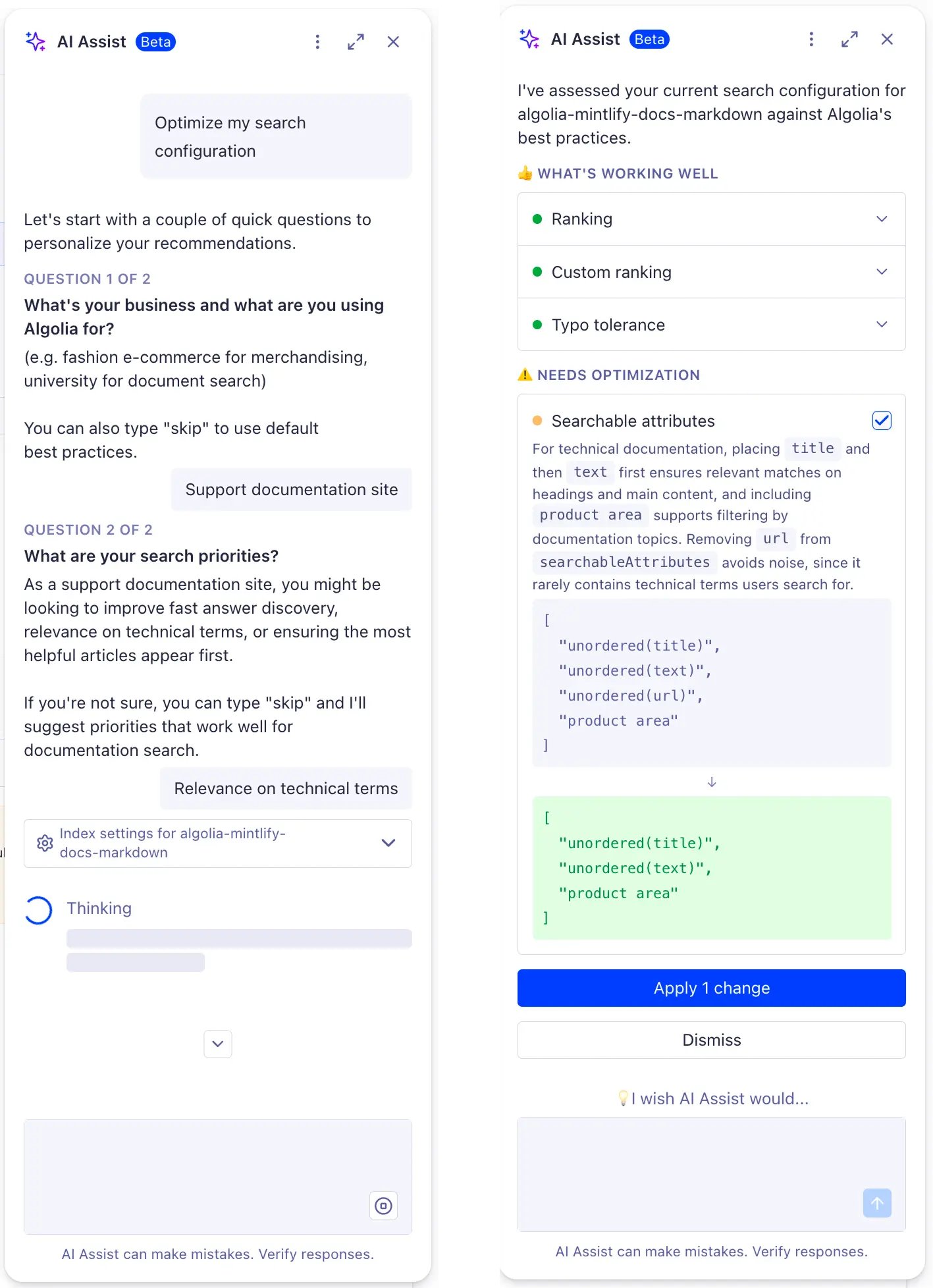
AI Assist is Algolia’s dashboard agent, helping our users to optimize their search, implement new features, and troubleshoot configurations.
When the AI Assist team started building its agent last year, they faced a choice that will be familiar to many customers: build a bespoke agent or build with Agent Studio. They chose the latter.
To help customers decide how to build their own agents, we sat down with the Assist team to hear why they chose Agent Studio and how they’ve built on the platform.
Q. What’s the story behind AI Assist?
“The idea for AI Assist came from a simple observation: customers wanted to use AI to automate routine search tasks, like interpreting analytics or refining search settings, so they could be more proactive with optimizing search and spend more time on strategy. We started building Assist last summer and were ready to launch within three months.
We began with a RAG-based chatbot that could answer questions about Algolia's features and products. Today, Assist is an autonomous, multi-agent experience that understands our customers’ search goals, suggests search strategies, and automates changes with their approval.” — Kenny Hong, Senior Engineer
Q. At the start of the project, what options did you consider for building an agent?
“Before we started building AI Assist, we assessed four options:
Build a bespoke agent
Use an open-source agent framework
Use a third-party solution
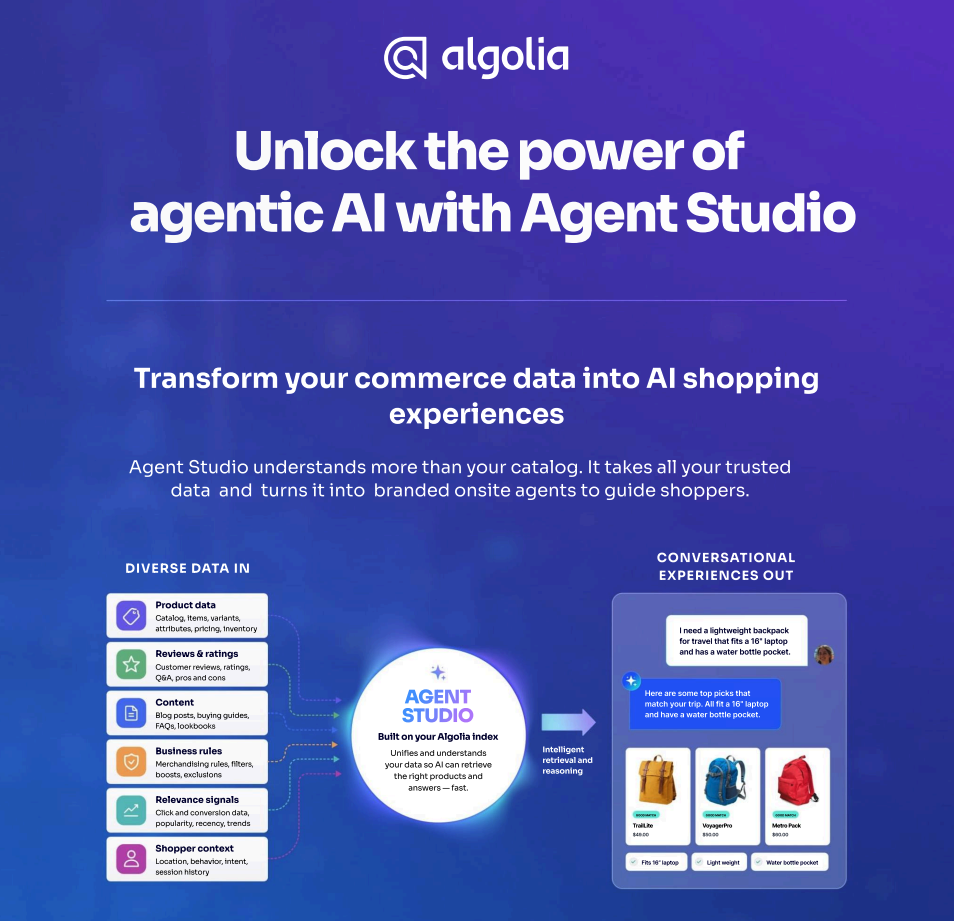
Build with Agent Studio
We quickly realized that building a bespoke agent wouldn’t just mean a huge investment in developing from scratch, it’d also require continual maintenance. An open-source framework would have reduced the initial development investment, but we’d still have to host, maintain, and govern everything else ourselves, on top of a learning curve and added complexity we'd have to absorb.
The team also explored using an out-of-the-box third-party solution. These would have been easy to integrate, but gave us little control: no ownership of customer data flow, limited ability to integrate with Algolia's own dashboard context, and pricing that didn't scale well with our needs.
Agent Studio provided the perfect middle ground — the freedom to build something custom, without the overhead of maintaining it ourselves.” — Kenny Hong, Senior Engineer
Q. Why did you choose Agent Studio over the other options?
“Speed to market. We were keen to release AI Assist as soon as possible. By using Agent Studio’s building blocks, we accelerated our time to market.” — Nguyen Duong, Machine Learning Engineer
“Dogfooding. We have a strong developer culture at Algolia, and believe we should make our services better by using them ourselves. You can see this across our product — search in our dashboard, website or documentation is all powered by Algolia.
Building AI Assist with Agent Studio also meant we could put the platform through the demands of a real production use case. By using it ourselves, we could identify opportunities, influence its development, and help make Agent Studio a stronger, more future-proof platform for our customers.” — Christopher Hawke, Engineering Manager
“Quality and long-term sustainability. This also gave us confidence in choosing Agent Studio. We knew the quality of the engineering behind the platform, the standards we hold our services to, and our commitment to continually improving them. We weren’t just choosing the fastest option for launching AI Assist; we were choosing a platform we believed could support us over the long term as agent technology evolved.” — Kim Björk, Software Engineer
Q. What engineering challenges did you encounter while building AI Assist, and how did Agent Studio help solve them?
“We wanted AI Assist to be aware of a customer’s context, like the features they had access to or the way they’d configured their dashboard, so it could offer more helpful, tailored advice. That came with two engineering challenges.
First, it meant Assist had to be dynamic, changing which tools and data it used based on the customer’s specific context. Second, we needed strict safety that ensured one customer's data never leaked into another's context.
Agent Studio's context and tool-injection model handled this natively, letting us scope exactly what data and tools were passed in per request without having to build our own isolation or access-control layer around every call.” — Kenny Hong, Senior Engineer
Q. Which Agent Studio capabilities have had the biggest impact on AI Assist?
“As we’ve developed AI Assist, Agent Studio’s Tools and Guardrails have been critical. Without tools, our agent would have to work out what data it needs for every request. With tools, the agent just needs to pick the right tool, allowing us to build more predictable workflows.
Guardrails allow us to protect users from any inappropriate interaction with Assist, and protect Algolia from any system abuse or reputational damage. We have full control of the guardrails, and can monitor the inputs and outputs that trigger them so we can adjust them over time. This has been essential to creating a production-grade agent.” — Taylor Johnson, Senior Engineer
Q. Looking back, how do you think AI Assist would be different if you'd built it from scratch?
“If we’d built Assist from scratch, we would have had to build and maintain everything Agent Studio gave us as part of the platform: safely isolating customer context and dynamically scoping tools per request, and production-grade guardrails against things like prompt injection and harmful outputs.
Building and operating all of that ourselves would have meant months of engineering time, and likely a dedicated team, spent on infrastructure instead of on what actually makes Assist useful to customers. The security, isolation, and guardrails work Agent Studio carried for us would have been a permanent cost had we gone bespoke.
AI Assist is always pushing the boundaries of Agent Studio’s capabilities, as we have significant engineering resources and are building at the frontier of agents. Being bespoke would mean we’re only accountable to our own roadmap, but we’ve found that the Agent Studio platform has developed at our pace.” — Kenny Hong, Senior Engineer
Q. For someone building their first agent with Agent Studio, what advice would you give?
“Spend time on your scope and prompt. As the subject-matter expert for your company and your users, you have the best idea of what your agent needs to know and are in the best position to write your agent’s prompt. Take your time with this. Be concise to avoid overflowing the model’s context window, but specific enough to address the edge cases. Keep your prompts organized and be intentional with iterations.” — Taylor Johnson, Senior Engineer
“Don’t rebuild what Agent Studio already solves. Before building anything custom, look at what Agent Studio provides: memory, tools, MCP-based integrations, and more. It's easy to spend weeks building your own version of something the platform already has a native answer for, so check what's available first.” — Kenny Hong, Senior Engineer
"Focus on your use case. AI Assist taught us that the hardest part of building a production-grade agent is making it genuinely useful. Spend time understanding your customer’s needs and use analytics to assess how your agent is being used. We’ve been able to invest time in understanding Assist’s use case because Agent Studio handled the architecture for us.” — Eliza Pepper, Product Manager











.webp)


.jpg)



%20(2).svg)