Most ecommerce teams have already tried some form of chatbot. If your experience looked like a frustrating flow of "I didn't understand that, please choose an option," you're not alone, but that experience has very little to do with what conversational AI in ecommerce actually is today and what it will become in the future.
This guide covers what conversational AI in ecommerce actually does, where it creates value across the customer journey, what it takes to implement well, and what separates implementations that deliver from those that disappoint.
Key takeaways:
Conversational AI understands intent and context dynamically; it is not keyword matching or scripted decision trees.
The highest-impact use cases are product discovery, personalized recommendations, post-purchase support, and FAQ deflection, each requiring different levels of data and system integration.
Data quality and backend integration determine implementation success more than the underlying AI model.
The right starting point is one high-volume, measurable use case with clean supporting data, not a full-journey rollout.
What conversational AI in ecommerce is, and how it differs from the chatbots you've already tried
The chatbots most ecommerce teams adopted a few years ago operated on a simple principle: if a customer says X, respond with Y. Developers hand-coded thousands of rules to handle anticipated inputs, but because human language has infinite variation, these systems broke constantly. A customer asking "where's my stuff?" and one asking "can you track my package?" were sending the same message, yet rule-based bots treated them as completely different inputs with no reliable way to map both to the right answer.
Modern conversational AI works differently because it learns from actual language patterns rather than relying on hand-coded logic. It processes natural language dynamically, understanding intent and context rather than matching keywords, which means it handles the messy, informal, and unexpected ways real customers actually communicate. For a deeper look at how conversational AI works technically, the mechanics are worth understanding before evaluating vendors.
The terminology can be confusing since "chatbot," "AI agent," and "virtual assistant" all appear in marketing materials, often interchangeably. For practical purposes:
Chatbots are the conversation interface through which automation happens
AI agents are systems capable of autonomous multi-step actions like processing a refund, checking live inventory, or completing a transaction
Shopping assistants / virtual assistants are the customer-facing names retailers give these capabilities in ecommerce contexts
What matters in practice is whether the system can execute actions when properly integrated with backend systems, or whether it can only answer questions.
Conversational AI in ecommerce, as a practice, is applying this technology to improve shopping, support, and discovery experiences across digital commerce channels.
How conversational AI works in ecommerce, and what non-technical teams need to understand
Three layers determine what a conversational AI system can actually do, and understanding them helps you evaluate vendors without needing an engineering background.
Language understanding
This is how the system interprets what a customer says: identifying what they want (intent), extracting relevant details like product attributes or order numbers, and maintaining the context of the conversation so that follow-up questions work.
Because conversational AI maintains dialogue history, a follow-up like "what about in blue?" is understood in relation to what came before. That's what makes the experience feel like a real conversation rather than a series of disconnected searches. Detailed explanations of how AI chatbots process language are useful context here.
Retrieval
This layer is consistently underestimated. The AI's response is only as accurate as the data it can access. If product catalog data is incomplete, if inventory is not synced in real time, or if policy documents are outdated, the conversational layer cannot compensate. When the underlying data is unreliable, the AI may give shoppers inaccurate answers that are too vague to be helpful.
This is why implementation quality, and specifically data quality, determines outcome quality more than which AI model powers the system. Algolia's AI Search is designed around this principle, combining keyword and vector retrieval with business rules so that conversational layers have accurate, well-structured data to draw from.
Execution
This layer is how the system connects to backend systems to take action rather than just answer. A conversational interface with no backend connections can only answer general questions. One connected to order management, CRM, inventory, and payment systems can execute full workflows autonomously.
The sophistication of the conversational experience you can deliver is ultimately a function of how deeply the system is integrated with your operational infrastructure.
Conversational AI use cases in ecommerce, and what it can actually do across the customer journey
It helps to think about conversational AI through the lens of the customer journey rather than by product category. Different stages present different opportunities, and different use cases require different levels of data maturity and system integration.
Journey stage
Use case
Primary value
Key prerequisite
Pre-purchase
Product discovery & guided selling
Conversion rate improvement
Attribute-rich product catalog
Pre-purchase
Personalized recommendations
AOV increase via upsell/cross-sell
Unified customer data
During purchase
Cart recovery & checkout help
Revenue recovery from 70% abandonment
Hesitation signal detection
Post-purchase
Order tracking, returns, refunds
Support cost reduction
OMS + payment system integration
Ongoing
FAQ deflection & support
70-80% automation of routine queries
Structured knowledge base
Not every use case is equally accessible at launch, which means starting with the right one matters.
Pre-purchase: product discovery and guided selling
Product discovery is where conversational AI has the most direct revenue impact. When a customer types "red dress for a summer wedding under $150," they're embedding color, occasion, product category, and price constraint into a single query. Traditional search requires customers to apply each of these as separate filters manually. Conversational AI extracts them automatically and narrows to relevant results in a single step.
The more powerful version of this is guided selling through back-and-forth dialogue. The AI asks clarifying questions to progressively narrow from a broad expressed need to a specific recommendation, much like an experienced sales associate would.
A customer asking "something comfortable for long flights" gets matched not just on product category but on attributes like fabric type, stretch, and packability, because the AI extracts those implied characteristics from the product data. This reduces decision fatigue, increases purchase confidence, and shortens the path to purchase, which is the mechanism behind the documented conversion improvements.
The prerequisite for this use case is well-structured, attribute-rich product catalog data. Vague or marketing-heavy descriptions like "premium quality craftsmanship" give the AI nothing to work with, while descriptions that specify materials, use cases, and sizing guidance enable accurate matching.
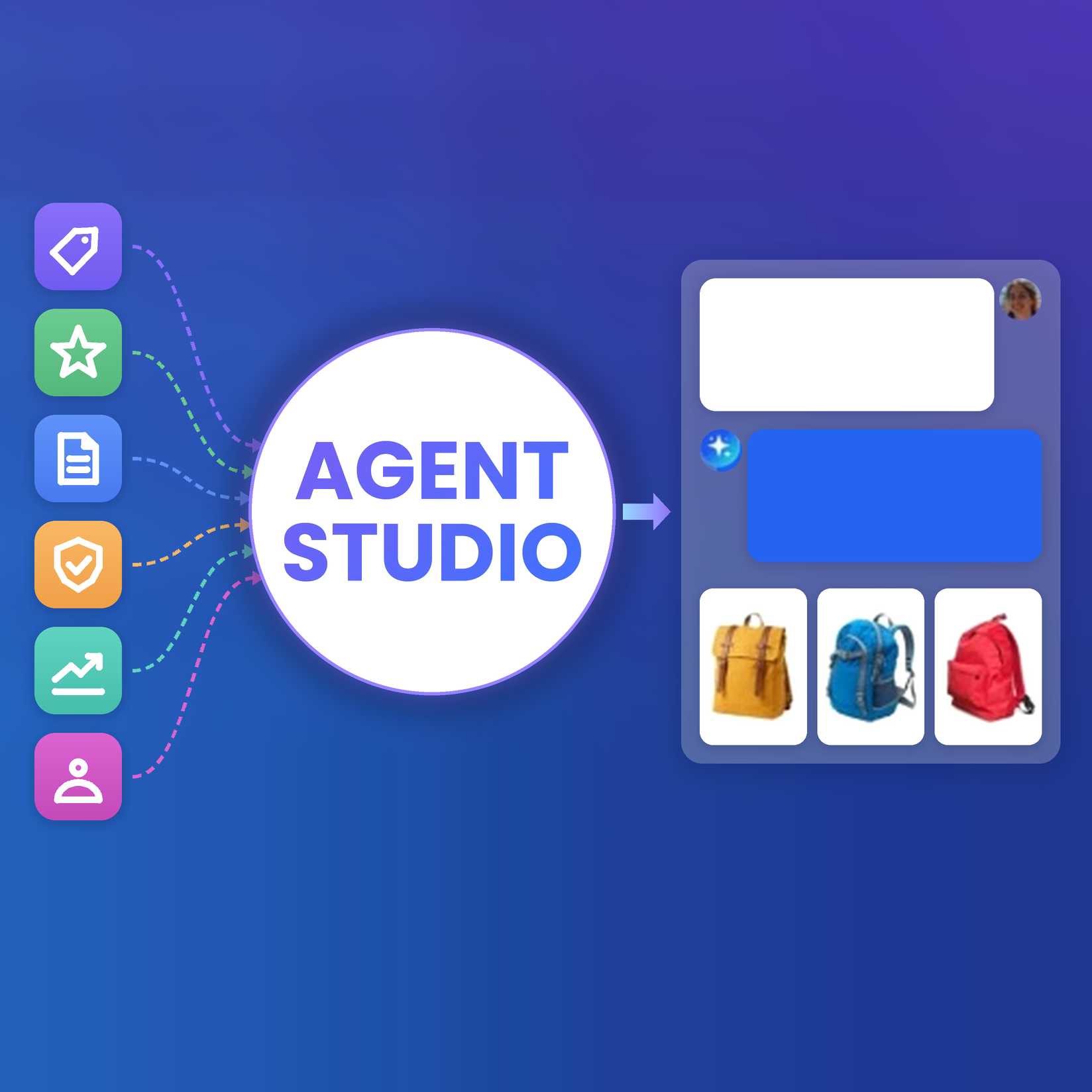
Algolia's Agent Studio provides a framework for building and deploying best-in-class ecommerce agents that answer natural-language shopping queries against a product index. Teams can configure the agent's role, scope, and retrieval constraints, and because it's a framework rather than a turnkey chatbot, they retain control over how the agent behaves and what data it draws from.
The retrieval layer, meaning the quality and structure of the underlying search index, directly shapes the quality of the answers the agent gives.
Conversational AI changes recommendations from generic to individually relevant because the conversation itself becomes part of the personalization signal. What a customer says during a chat session, combined with their purchase history, browsing behavior, and loyalty data, enables recommendations that reflect genuine preference rather than statistical popularity.
Anonymous browsers; in-session signals like pages viewed, items added to cart, and filters applied
Upsell and cross-sell opportunities surface naturally within conversation. A question like "since you're buying running shoes, would moisture-wicking socks be useful?" feels like a helpful suggestion rather than an interruption. That's the key difference from static recommendation widgets, which respond to historical data but cannot adapt based on what the customer says during the session.
Implementations document revenue improvements of 5 to 40% from personalized recommendations according to McKinsey, though results depend on how complete and current the underlying customer data is.
Algolia’s AI Recommendations powers this layer by connecting behavioral signals to what gets surfaced next within a conversational experience, enabling the kind of contextually relevant upsell and discovery moments that drive AOV at scale. Real-time personalization enables ecommerce brands to improve recommendations for first-time visitors to the site, too.
Customers increasingly land directly on product detail pages (PDPs), category pages, or content pages, and continue refining their decision from there. They want to ask agents on those PDPs follow-up questions, compare alternatives, and reconsider trade-offs in context. Best-in-class commerce agents work inside search results, category pages, and PDPs, and extend discovery from the moment a visitor lands on your site.
During purchase: cart abandonment recovery and checkout assistance
The average ecommerce cart abandonment rate sits around 70%, meaning most potential revenue is lost after customer intent is already established. Conversational AI improves recovery not through generic reminders but through personalized intervention triggered by hesitation signals, like lingering on a product page, comparing multiple similar items, or attempting to exit.
The difference is the specificity of the recovery message. Referencing the exact product, addressing a likely objection like price or shipping cost, or surfacing social proof specific to that item converts at meaningfully higher rates than a generic "you left something behind" email.
Within the purchase flow, the AI can also answer last-minute questions about return policies, sizing, or shipping timelines without forcing customers out of checkout and into a support queue. Multichannel follow-up through WhatsApp, SMS, or email, using the customer's preferred channel, extends this capability beyond the session.
Post-purchase: order tracking, returns, and refunds
Order status is the most common customer service query in ecommerce, making it the clearest candidate for AI automation. Unlike guided selling, it doesn’t require complex judgment, it requires real-time data retrieval.
What conversational AI adds over a static tracking link is the ability to handle follow-up questions: "My delivery window passed and it hasn't arrived. What should I do?" routes intelligently based on context rather than dropping the customer into a generic support queue.
Returns and refunds are where the multi-step workflow capability of conversational AI becomes valuable. The AI can:
Check return eligibility based on purchase date and item type
Guide the customer through the process step by step
Initiate refunds autonomously for qualifying scenarios
Log the return reason for merchandising analysis
That return reason data has operational value beyond the transaction itself. Structured feedback collected at scale gives merchandising teams a signal on product quality issues or inaccurate descriptions they would otherwise miss.
This use case requires live integration with the OMS and, for refund execution, payment systems, because the ability to complete a multi-step transaction autonomously is what separates conversational AI from a basic FAQ bot.
Customer support deflection and FAQ resolution
High-volume routine inquiries like refund policies, shipping timelines, size guides, and store policies are great candidates for automation because they are answerable from structured knowledge bases and do not require judgment. Well-configured systems achieve 70 to 80% autonomous resolution rates for these queries, with 20 to 30% still requiring human agents. That remaining portion is a design requirement that should be planned for from the start, which means escalation design matters as much as resolution rate.
The important nuance is that support automation should be designed for resolution rather than deflection. A system that loops customers through failed responses without solving the problem or offering a human creates worse outcomes than no automation at all.
The business case: what realistic outcomes look like
The performance data for conversational AI in ecommerce is well-documented, though it varies meaningfully by use case and implementation quality. Here's what credible sources report:
Conversion rate improvements of up to 23%, with 4x lift for AI-engaged shoppers. Glassix research found AI chatbots enhance ecommerce conversion by 23%, and Rep AI's analysis of 17 million shopping sessions found that shoppers who engage with AI chat convert at 12.3% compared to 3.1% for non-engaged visitors. The mechanism is fewer decision friction points and a faster path to a relevant product.
Revenue lifts of 5 to 40% from personalized recommendations. McKinsey research shows personalization lifts ecommerce revenue by 5 to 15% at baseline, with companies that excel at AI-driven personalization seeing up to 40% more revenue. In conversational contexts, real-time upsell and cross-sell recommendations are the primary driver.
Support cost savings of 30% or more. Gartner forecasts that conversational AI will reduce contact center agent labor costs by $80 billion in 2026, with per-interaction costs dropping from $7-12 for human agents to roughly $0.40 for AI-handled calls. A Forrester study found one composite organization saved $10.3 million over three years, with ROI up to 391%.
Break-even within 60 to 90 days is reported by enterprise platform vendors, though independent verification of this timeline is limited. Conservative planning should budget for a 3-6 month ramp.
Customer satisfaction improvements follow from faster response times and 24/7 availability. HubSpot research reports that immediate response is important or very important to 90% of consumers, and conversational commerce research confirms this pattern across retail specifically.
Keep in mind that these ranges describe well-executed implementations. Poor implementations, however, can actively damage customer satisfaction by creating experiences worse than no automation at all. The gap between high-performing and low-performing deployments comes down to data integrity, integration completeness, intent classification accuracy, and ongoing optimization discipline, not the underlying AI model.
The right measurement approach is to establish baseline metrics before deployment, measure the same metrics after, and control for seasonality and other variables when attributing changes. Pick two or three metrics directly tied to the use case you are deploying, and track those specifically rather than broad business metrics that are harder to attribute.
What conversational AI in ecommerce actually requires, and the prerequisites most teams underestimate
The technology itself is rarely the limiting factor in implementation success or failure. Organizational readiness, meaning data quality, system integration, and continuous improvement discipline, determines outcomes far more than which AI model the system runs on.
Clean, complete, and connected data
Data requirements are more specific than most teams expect. Before building anything, assess your readiness across four areas:
Product catalog data: AI recommendations and natural language search are only as accurate as the catalog data they draw from. Product descriptions need to include relevant attributes like materials, use cases, fit characteristics, and size guidance, because the AI extracts these to answer shoppers' questions. Vague copy isn't just unhelpful for human readers; it is invisible to the AI's matching logic. Data enrichment and data transformation tools can help close gaps in catalog quality without rebuilding your product data from scratch.
Customer data: personalization requires unified customer records with purchase history, preferences, loyalty tier, and return patterns accessible from a single place, not scattered across disconnected systems.
Real-time synchronization: a customer asking "is this in stock?" and receiving a yes when the item is out of stock creates a more damaging customer experience than no AI at all. Inventory, pricing, and availability data must be synced in real time for high-stakes use cases.
Event data: behavioral signals like clicks, searches, purchases, and add-to-cart actions are the raw material for better personalization.
Conducting a data audit before implementation prevents the expensive and frustrating experience of discovering inadequate infrastructure after you've already committed.
Algolia's AI readiness assessment guide offers a structured framework for evaluating where your data stands before committing to a conversational AI deployment.
Data privacy and compliance
Conversational AI systems process customer data including browsing behavior, purchase history, and potentially payment information. Teams should involve legal and compliance stakeholders early to ensure the implementation meets GDPR, CCPA, and any industry-specific requirements. This includes data retention policies, consent mechanisms, and clear disclosure that the customer is interacting with an AI.
Backend system integration
The integration spectrum determines what the AI can actually do. At minimum, the AI needs read access to product catalog, inventory status, and customer order history. For full-capability implementations, it needs write access to execute actions like processing refunds, updating records, initiating returns, and completing transactions. The typical system connections include:
Depending on use case: ERP, warehouse management, or loyalty systems
Pre-built integrations to major ecommerce platforms reduce implementation complexity considerably, while custom-built or legacy systems require bespoke integration work that substantially increases timeline and cost.
Governance decisions should be made explicitly before deployment. Determine what the AI can execute autonomously versus what requires human approval (for example, a standard return within policy versus an exception-based refund above a certain value). These decisions are far easier to make proactively than to discover after launch.
The "chatbot says it will help but can't do anything" failure mode results specifically from building a sophisticated conversational interface without adequate backend integration.
When evaluating platforms, the useful question to ask is how much integration work is abstracted by the vendor (through pre-built connectors for major ecommerce platforms) versus how much falls to your in-house team as custom development.
Thoughtful human handoff design
Because AI resolution rates of 70 to 80% mean 20 to 30% of interactions require a human, escalation design is a core implementation requirement that should be addressed before launch. Effective escalation has three elements:
The customer can trigger it at any point without friction
The AI detects frustration signals and proactively offers escalation before the customer has to ask
The full conversation history transfers to the human agent so the customer doesn't have to repeat themselves
The clearest measurement signal for poor escalation design is customers who contact support a second time to resolve the same issue after an AI interaction.
Continuous optimization, not one-time setup
AI systems require following best practices, plus continuous training on real customer conversations, because product catalogs evolve, language patterns shift, and new edge cases emerge. Systems trained only on historical data gradually underperform without retraining. The optimization loop runs from conversation data to identifying failure patterns to retraining or reconfiguring to re-evaluating, and it should run on a defined cadence rather than ad hoc.
The metrics to track continuously include intent classification accuracy, resolution rate, customer satisfaction scores for AI versus human interactions, and conversion impact for sales-focused implementations.
Implementations that lack clear ownership (someone accountable for monitoring performance, identifying degradation, and driving improvement) reliably stagnate within months of launch.
Why conversational AI implementations fail, and common patterns to recognize before you start
The failure modes for conversational AI in ecommerce are consistent enough that most can be checked against before committing resources.
Poor intent classification
When the AI misunderstands what the customer wants, everything downstream fails. A customer saying "I want to return this" who gets routed to product information instead of returns procedures is experiencing intent classification failure, which typically results from weak training data, poorly defined intent taxonomies, or failing to test against real customer language before deployment. The fix is training on actual customer conversation logs rather than internal documentation or FAQ text, since internal language rarely reflects how customers actually speak.
Weak or incomplete product data
The AI cannot describe products accurately, make relevant recommendations, or answer product questions if catalog data is missing attributes, uses internal jargon, or is inconsistently structured. Treating data quality improvement as a parallel workstream rather than a prerequisite is one of the most common sequencing mistakes teams make, because the conversational layer will expose every gap in the underlying data.
Missing backend integration
Conversational interfaces without backend connections can only answer general questions; they cannot check live inventory, process refunds, or retrieve order status. Customers experience this as AI that promises help and delivers nothing, which is worse for satisfaction than no automation at all.
Absent or poor escalation logic
Systems that loop customers through failed resolution attempts, or transfer to human agents without conversation context, destroy the trust that good early interactions build. Escalation design should be tested before launch with real failure scenarios, not just the happy path.
No ongoing optimization ownership
Customer language, product catalogs, and behavior patterns evolve continuously. Without someone accountable for monitoring and improving the system, implementations plateau and degrade. Performance ownership should be treated as a defined role, with a regular review cadence, rather than something the team plans to figure out after launch.
How to get started, and choosing your first conversational AI use case
A good rule of thumb is to start narrow by selecting one high-volume, low-complexity use case where success is measurable and the downside of underperformance is contained. The temptation to automate the entire customer journey at once is understandable but reliably produces poorly executed broad implementations rather than well-executed focused ones.
Three use cases work well as entry points, each with different tradeoffs:
Order tracking and post-purchase status inquiries are high-volume and routine, requiring OMS integration but not complex judgment, making them the lowest-risk starting point.
FAQ and policy deflection are high-volume and answerable from structured knowledge bases without requiring transaction execution, though they need well-organized help content to work well.
Natural language product discovery has the highest conversion impact but requires well-structured catalog data, and is directly measurable through A/B testing against traditional search.
Before selecting a use case, ask one question: "Do we have the data and system connections this use case requires to actually work?" If the answer is no, resolve those prerequisites first or choose a different use case that better matches your current infrastructure.
The measurement setup should happen before deployment, not after. Pick two or three metrics directly tied to the chosen use case, measure them now, and use them as the baseline against which AI performance is evaluated.
Routing a defined subset of traffic to the implementation and evaluating performance against that baseline gives you real data to make the scale decision, rather than relying on vendor projections.
Getting started with conversational AI
Conversational AI in ecommerce is past the hype phase. The technology works, the business case is documented, and the failure modes are predictable. What separates teams that capture real value from those that don't comes down to the same handful of factors covered throughout this guide: clean and connected data, thoughtful backend integration, frictionless escalation design, and someone accountable for ongoing performance.
Start with one high-volume use case where you have the data to support it, measure against a baseline, and scale based on what the results actually show. The foundational work you do now (catalog quality, system integration, event data collection) won't become obsolete as the technology evolves. It becomes the prerequisite for capturing each successive wave of capability, from agentic search to AI shopping assistants and beyond.



.webp)














%20(2).svg)