You've probably already heard about the ramifications of generative AI (GenAI) technologies on how we work and do business. However, investigating this technology's more nuanced impacts uncovers a more technical story.
Beyond using GenAI to draft a letter to a client or an essay on Abraham Lincoln in seconds, AI-based technology has also significantly transformed the possibilities for customer journeys and engagement in the ecommerce space.
The technology has opened up a new realm of more impactful, meaningful, and personalized online experiences, turning a monochrome shopping journey into a rich palette of innovative and creative interactions between merchants and end users.
Under the hood, AI is driving a revolution in the complex architecture and capabilities of the systems that power the online shopping experience at the front, as well as the back end of the computing stack.
AI: Optimizing search tools and 'the stack'
Organizations use GenAI and large language models (LLMs) to optimize search and discovery. The technology employs complex machine learning algorithms capable of searching and organizing vast amounts of data, very quickly.
It impacts the way search is done and the overall design of the tech stack by changing how information is used and shared across different business and operational applications.
AI is not only an integral part of Algolia’s NeuralSearch engine — AI integration is also one of the principles driving the move to headless architecture.
This approach makes it easier to decouple what were once monolithic, single-provider systems into flexible, interchangeable and modular API-based applications.
Content standards
As GenAI-powered solutions are used more dynamically and creatively through the tech stack and at critical customer touchpoints, evaluating and maintaining high content standards is a technical and ethical priority. It is also a strategic necessity, because the quality of AI-generated content has a direct and lasting impact on user satisfaction, engagement, brand reputation, and critical business outcomes.
Generative AI: what is it?
Learning all the new terminology surrounding AI can be bewildering. Key terms like GenAI often encapsulate other parallel, critical
technologies like large language models (LLMs) that operate alongside and in tandem. Here are 15 key terms to remember when discussing artificial intelligence.
- Generative AI (GenAI)
A form of artificial intelligence that can generate content like text, images, and code by applying machine learning techniques to huge data sets.
- Large language model (LLM)
AI models specifically designed to understand and generate human language. These models are trained on vast amounts of written content, enabling them to understand context and grasp the nuances of natural language.
- Machine learning (ML)
A form of automated computer learning, adaptation, and training that uses complex algorithms and draws inferences from large data sets. Neural networks and deep learning are types of ML.
- Natural language processing (NLP)
A technology system that analyzes, interprets, and responds to text or voice so that people can interact with an AI in regular, everyday human language.
- Bias
When an AI model’s outputs reflect unfair or prejudiced patterns in its training data, leading to potentially skewed results in future outputs.
- Chunking
A way for LLMs to break query responses into smaller segments to confirm that the content is appropriate and reliable.
- Data lake
A repository that can store large amounts of raw and structured data for big data and machine learning retrieval.
- Emergent abilities
New, unexpected abilities or behaviors that an AI wasn’t directly programmed to do.
- Explainability
Understanding how an AI model makes decisions. Explainability is essential for trust and transparency.
- Hallucinations
When an AI responds with incorrect or misleading information based on inaccurate data.
- Inference
The process by which an AI model applies what it learned during training to make predictions or generate outputs based on new data, like a prompt.
- Outputs
The results generated by an AI model, such as personalized product recommendations, a chatbot’s response to a question, or an image created from a text description.
- Parameters
Adjustable components within an AI model that determine how a model behaves, processes data, learns patterns, and makes decisions. An AI model will continuously adjust its parameters during training to reduce error.
- Prompt
The user-generated input that initiates an AI model and guides the creation of outputs. For example, a question that you ask a chatbot.
- Training
How the AI model learns to perform tasks. The model is fed large amounts of data to learn patterns, make predictions, and generate outputs.
GenAI and search
How do we apply Gen AI’s ability to create outputs like text, images, and code to improve information architecture and flow management in an ecommerce setting?
One of the first steps is using the technology to optimize the tools in the computing stack for clarity, relevance, and ethical standards.
To understand how this works, we must break down the search process and examine how search results and product descriptions are generated using indexed data.
Algolia’s NeuralSearch, for instance, combines vector, neural, and keyword search to generate meaningful results. It identifies patterns in words based on their meanings using machine learning and artificial neural networks.
The technology uses NLP to interpret a customer’s search query accurately. Then, it uses AI and vector manipulation to retrieve and rank meaningful search results from an index of product items and descriptions.
Adding another intelligent layer
GenAI adds another layer of understanding to the search process and the components that make up the compute stack. It optimizes search systems by better maintaining the content lake of indexed data the search technology draws from.
It also enables sophisticated personalization and product descriptions that businesses can dynamically adjust based on user behavior, search trends, and other real-time data inputs.
Alongside ensuring that the data lake is well organized and set up to deliver the best results, GenAI helps control biases and hallucinations that can skew search output by filtering information that does not make sense or is offensive.
Quality of AI models and GenAI content
The attributes of AI-generated search content, like a product description or personalized catalog, depend heavily on the quality of
the underlying AI model and the data used to train it.
A GenAI system can produce many different results based on the same input. That’s why evaluating the quality and performance of AI-generated content in a search application is so important.
What sets GenAI apart from other technologies is that the rich data collected by AI tools also provide the information needed to evaluate these systems and adjust their performance. The ability to assess then adjust GenAI parameters makes crafting meaningful outcomes easier, ultimately driving user satisfaction and increasing engagement.
Evaluating quality: AI-generated content
That AI can generate many different results based on the same input is a characteristic that GenAI technology experts refer to as having a high potential variability of outcomes.
As a result, the need to evaluate outputs and the range of outcomes is a critical component of any GenAI implementation. It is a way of confirming that the content created by the AI system is relevant and accurate and not misleading or biased.
AI-content generating systems can use real-time feedback loops to monitor and adjust output, embedding content moderation systems directly into the GenAI implementation while they create new content.
These systems can also be designed to generate predictable outcomes and meet user expectations that enhance the online experience. By controlling and adjusting parameters, training and testing, GenAI can be a powerful tool for meeting and surpassing business objectives.
Content generation and evaluation
AI evaluation involves both quantitative and qualitative criteria to help filter GenAI output. It controls misinformation and the hallucinations that generate outputs that might be factually incorrect or offensive. Users have to feel that the AI-generated outputs are reliable and that the system is transparent about how it operates.
An effective GenAI system should allow users to tweak outputs through adjustable settings or interactive feedback. Ultimately, the interaction between user and AI enhances creativity and adapts the results to meet the user’s unique needs.
Quantitative metrics used to evaluate Gen AI
Here is a list of some of the important qualitative assessment tools and techniques that can be applied to shape GenAI outputs:
-
Readability assessment: Is the AI-generated content accessible and understood by users? Tools like the Flesch-Kincaid readability score can be used to determine if reading levels are appropriate for the target audience.
-
Cognitive load: Does the content contain complex grammar or language that could be simplified to make it more accessible, increasing user engagement and lowering bounce rates? Generated content can be evaluated using tools like Textstat that help limit long sentences, passive voice, and complex words.
-
Sentiment and moral analysis: Tools like the AFINN lexicon, VADER or TextBlob can monitor and adjust the sentiment in AI-generated content. These tools help ensure that responses sound empathic and warm. Resources like the Extended Moral Foundations Dictionary (eMFD) limit the likelihood of producing AI-generated content that promotes harmful stereotypes or doesn’t adhere to ethical guidelines.
-
Engagement metrics: This more familiar data still remains extremely useful and pertinent. It allows ecommerce businesses to analyze user interaction with their content, such as click-through rates, time-on-page, and bounce rates and measure how effectively the content holds the end user’s attention.
Qualitative evaluation - What is retrieval-augmented generation (RAG)?
One of the most profound implications of generative AI for search and discovery is the emergence of retrieval-augmented generation (RAG).
RAG enriches content and makes it more accessible and relevant to specific search queries by integrating external knowledge retrieval with content generation.
At the same time, it serves as a powerful mechanism to apply qualitative assessment criteria to search outputs in the retrieval, rankings, and product description generation process.
It uses metrics like faithfulness and context precision to measure how well GenAI content aligns with user queries. The process involves chunking, or breaking, query responses into smaller segments to confirm that the content is appropriate and reliable.
Elevating content usability
When a user submits a query, the RAG system goes beyond simply using the pre-existing knowledge in the LLM. Instead, it actively
searches through a database of documents or content pieces to locate the most pertinent information.
The retrieved content is then fed back into the LLM, which generates a response that is coherent and grounded in up-to-date, specific information from the other databases.
RAG is a powerful way to optimize and enhance the content retrieved from a vector database. The LLM embeds the content into a coherent response while incorporating multiple sources of relevant and available content.
At the same time, a RAG Assessment System (RAGAS) analyzes for faithfulness and context precision to improve content relevance and deliver personalized and meaningful output.
RAG ensures that any AI-generated information presented is accurate and contextually useful. Whether the inputs are made by a sales executive seeking the latest marketing collateral or a product engineer looking for updated specifications, RAG can account for the user, their history, and a range of other selected variables to create impactful GenAI content.
Why search is important across the stack
As more components in the computing stack integrate AI functionality, an AI stack built around GenAI-powered components is becoming the new industry standard.
AI-powered functionality is becoming distributed across an array of different components. Those looking to build complex AI-powered ecommerce platforms can now choose LLMs, orchestrators, monitoring, and cloud services — all AI-supported — from an array of different providers as they build their headless ecommerce capability.
When it comes to search, GenAI is already commonly used to understand search queries and better organize, maintain, and process information from the data layer it uses to retrieve and rank results and generate product descriptions.
GenAI also enables
- Innovative descriptive and generative capabilities in the operational layer impacting UX and UI, as well as the creation of new resources like personalized shopping guides"
- More efficient business process automation and optimization in the operational layer, improving marketing and order processin$
- Better network traffic and user request management by outsourcing functionality in the data layer to LLMs, increasing traffic and content delivery capabilities
The impact of GenAI on business
When traffic spikes but sales don’t match the number of shoppers, an ecommerce retailer might wonder if their users are not finding the products they need.
While implementing powerful GenAI solutions is an important part of creating the kind of online experience users now expect, technical knowledge is only one part of the equation.
In addition to maintaining and ensuring the quality of content and adjusting parameters to deliver the best results, assessing whether GenAI outputs meet customer goals and expectations is crucial.
It is also essential to constantly evaluate and ensure that the GenAI-powered search and discovery experience aligns with business objectives and strategic goals, like brand trust, customer loyalty, and operational efficiency.
Building transparency and trust
One of the core responsibilities of GenAI designers is to shape and align user expectations. Users do not want to feel coerced or
manipulated by intelligent technology.
Clear communication and well-designed user interfaces can help users form realistic mental models about how generative systems function. Providing customers with a rationale for an output and explainability for how a GenAI-powered platform arrived at a result helps foster that trust. Here are some ways GenAI designers can do this:
- Provide a sidebar alongside a search result that explains outcomes based on a past purchase
- Give users the ability to re-rank a numbered search result
- Include explanations alongside outputs that generate pricing for B2B clients or product recommendations for B2C clients
Businesses should embrace creative possibilities rather than lean towards guided and deterministic output. Taking this approach fosters trust and generates enthusiastic and confident user experiences.
Conclusion: Integrating Algolia
Empowering customers by using GenAI-powered search and discovery is critical to building a relationship with new clients and fostering deeper connections with existing ones.
Every opportunity to meaningfully engage your online user is also a way of making the online experience feel less programmed and more organic.
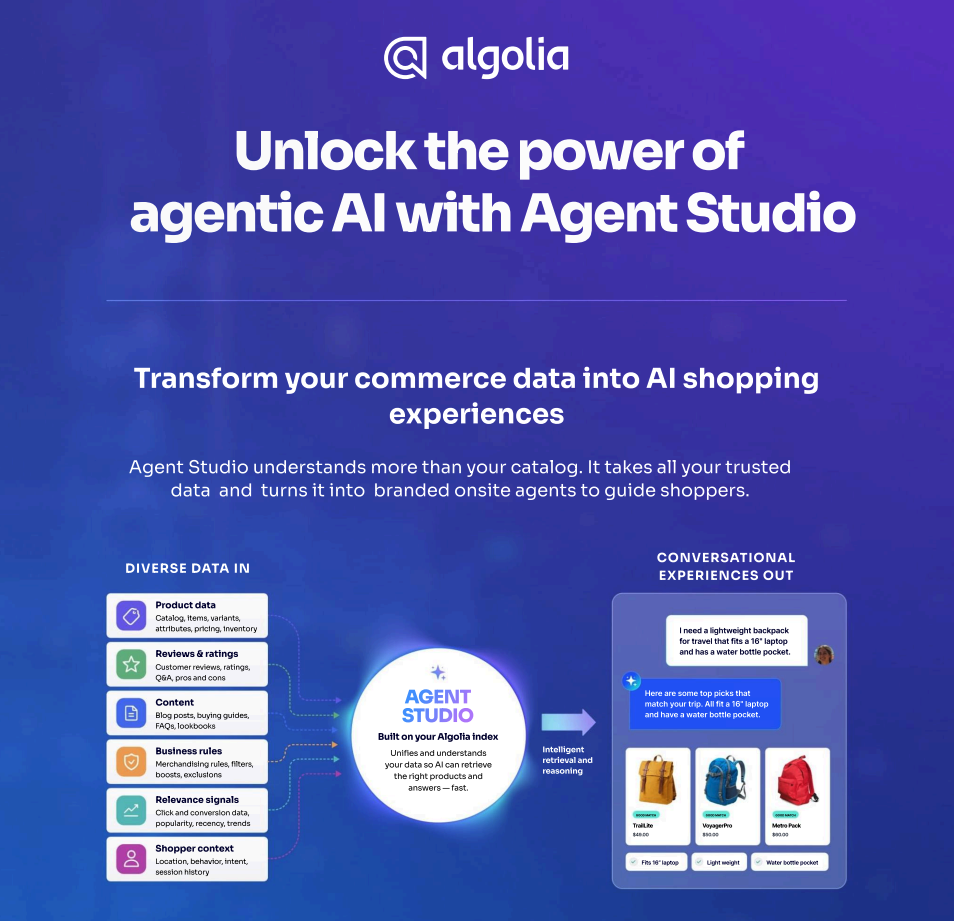
Algolia provides businesses with the enabling tools to drive the customer experience and generate bottom-line results.
Ecommerce faces significant challenges in meeting audience expectations for relevant, accurate, and personalized information.
With leading-edge GenAI-powered tools and technology like our GenAI Toolkit, teams can go from idea to production in minutes.
- Connect your existing Algolia search indices with leading LLMs to power AI-driven text generation across your application:
- Combine the power of your search data with your choice of LLM to create intelligent and dynamic application:
- Transform product catalogs into dynamic AI-generated shopping, category, or comparison guide:
- Use the no-code Algolia Merchandising Studio to help match AI output with your brand voice and product details
GenAI offers a powerful solution that drives search and discovery. It automates the creation of material that aligns with diverse audience segments, enabling efficient information management and improved flow architecture.
The Algolia GenAI approach touches the full tech stack through a range of transformed search solutions and experiences. For savvy business leaders, it is an opportunity to align their stack and sharpen their competitive edge.




.webp)


.jpg)










%20(2).svg)