If you have not seen this comedy-drama yet, it is worth adding to your list.
There’s a moment early in the film where Miranda walks into the office and the entire environment reorganizes itself around her. Assistants move faster. Phones start ringing. Coffee appears. Problems disappear before they are even mentioned.

Nobody asks Miranda what she wants because the expectation is already understood. She does not manage workflows. She manages outcomes.
That idea has been stuck in my head while thinking about the future of AI-powered commerce, especially in luxury fashion.
Because most agents today still behave like Andy Sachs on her first day at Runway. They wait for instructions. You prompt them, clarify your intent, refine your request, and try again. Even when the agent succeeds, it requires effort.
But luxury shoppers do not think in prompts. And luxury brands do not design experiences around friction. They expect anticipation.
That is why agentic AI feels like such an important shift and why Algolia’s approach to AI-powered search and discovery stands out.
Beyond the chatbot era
Most enterprise AI today is centered around ad hoc interactions. You ask a question, generate some copy, summarize a document, or rewrite a paragraph. These capabilities are useful, but they are fundamentally reactive and most importantly, not agentic.
The human remains responsible for orchestrating the experience.
Commerce does not work like that. Fashion commerce, in particular, is continuous, contextual, and often emotionally driven. It changes with seasons, trends, geography, inventory, and cultural signals, often all at once.
A shopper searching for a black dress during Fashion Week is not looking for the same thing as someone searching during wedding season or holiday travel. The intent is fluid, implied, and often unspoken.
Traditional systems struggle because they expect structured behavior. Luxury shoppers behave more like Miranda Priestly. They expect the system to understand nuance without needing explanation.
The difference between assistants and agents
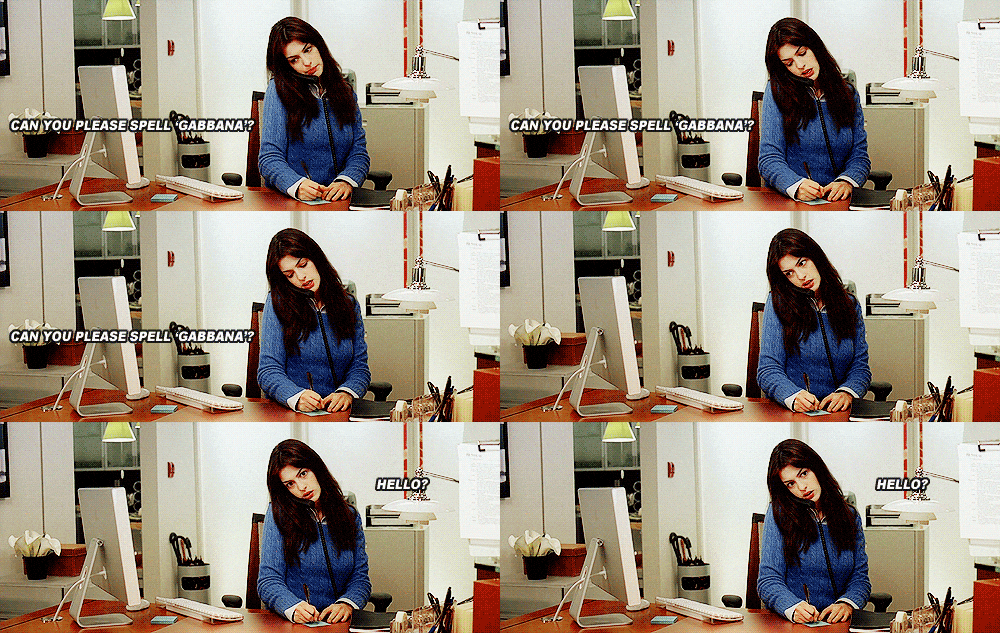
Andy only becomes successful once she stops acting like a traditional assistant.
At the beginning of the movie, she constantly asks follow up questions. She tries to clarify every detail before acting, which only adds friction to Miranda’s day. What Miranda actually expects is someone who reduces cognitive load.
Over time, Andy evolves. She learns context, anticipates needs, adapts dynamically, and executes without supervision.
This is the difference between an AI assistant and an AI agent.
An assistant waits for prompts. An agent operates within a defined role and continuously acts based on context, goals, and available tools.
That difference from reactive to proactive is where real, agentic value begins.
Algolia’s approach to agentic commerce
What makes Algolia’s fashion strategy stand out is that it does not treat AI as a layer plonked on top of commerce. It treats AI as part of the operational fabric of the experience itself.
Algolia already powers search and discovery for more than 75% of luxury fashion brands. That scale matters because fashion is not just another ecommerce category. It is deeply tied to identity, storytelling, and brand perception.
Luxury brands are not simply selling products online. They are extending their brand experience into digital channels. Every interaction, starting with search, must feel intentional and tightly aligned with the brand.
Algolia’s positioning reflects this clearly. Algolia gets fashion.
The focus is on delivering premium brand value in ways that resonate, through a curated, high-end discovery experience, personalization that becomes more precise with every interaction, and digital journeys that reflect the brand rather than simply presenting the catalog
Because fashion leaders are not buying infrastructure. They are investing in enhanced storytelling and desirability, even when the interface is powered by AI. Helena Rubenstein famously noted “we don’t sell cosmetics, we sell hope.” Equally, a lipstick is never just a shade, and an AI interaction is never just a utility, they’re both vehicles for something deeper. It has to become an extension of mood, identity, and a version of the brand translated in a digital presence. The agent has to guide, suggest, and converse in a way that feels intentional and, importantly, on brand.
Fashion shoppers do not search like databases
One of the hardest problems in fashion commerce is language.
Shoppers do not search using structured product attributes. They search using emotion, culture, and a desire to keep ahead of trends. Terms like quiet luxury, old money, or vacation linen do not map neatly to a product catalog, yet they carry clear intent.
Traditional keyword based systems break down in these scenarios.
Algolia addresses this with AI search that understands meaning, context, and the ever-evolving fashion language. Its LLM interprets intent beyond keywords and adapts to how shoppers actually express themselves.
More importantly, the agent continuously evolves. It does not require constant manual updates from merchandising teams.
This is where the experience begins to feel agentic. The system does not just respond. It adapts. That adaptability is critical in an era when fashion trends move impossibly fast.
During premiere week for The Devil Wears Prada 2, searches for Meryl Streep increased 71% week over week across Algolia’s platform, clear evidence of how quickly cultural moments reshape shopping intent. An agent that responds to that search with “no results,” or simply surfaces Meryl Streep merchandise, misses the mark. The better experience understands the intent behind the query, presenting luxury blazers and other workwear-inspired looks that capture the polished aesthetic Miranda Priestly made iconic. When agents adapt interactions to both personal preferences and timely trends, the experience feels curated, relevant, and narrative-driven, anchored in a point of view rather than a generic assistant voice. The AI is not there to answer questions in isolation, but to shape a journey, add emotional weight to choices, and reinforce the world the brand has built.
In that sense, agentic AI is treated less like infrastructure and more like a new storytelling surface, one that needs to express taste, restraint, and identity at every step.
The Shopping Assistant as a digital stylist
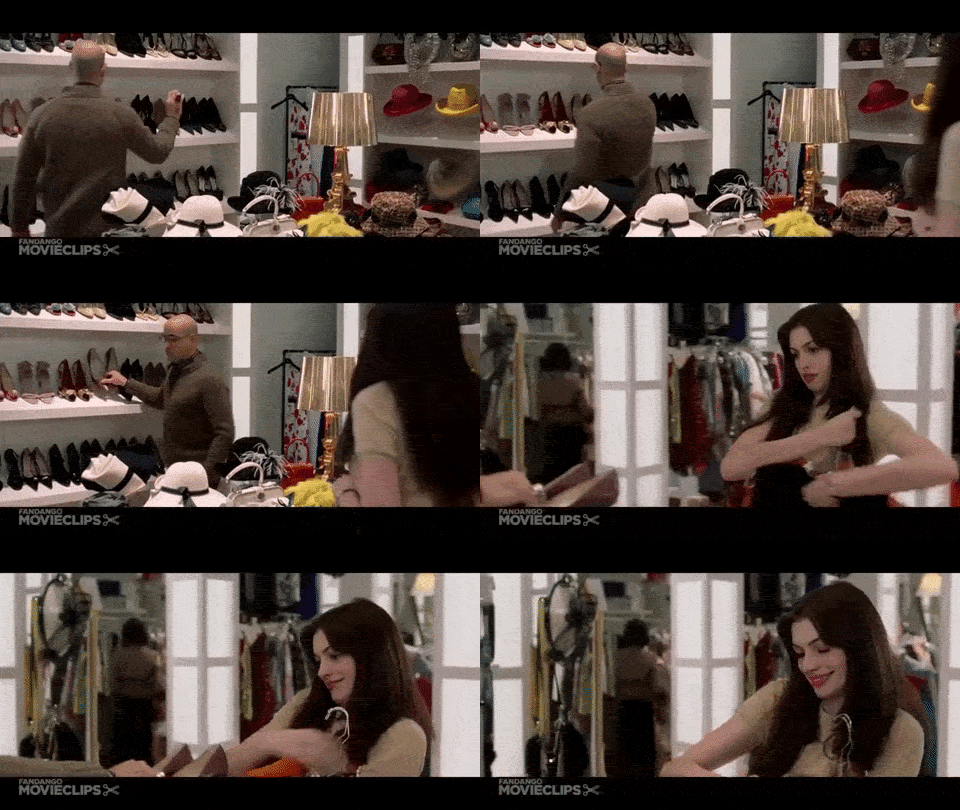
One of the most compelling aspects of Algolia’s approach is how it reframes AI from automation into the aforementioned curated and narrative-driven consultation.
In The Devil Wears Prada, Nigel plays a crucial role. He provides context, guidance, and curation. He helps translate complexity into something actionable.
That is a much better metaphor for AI in commerce than a generic assistant or chatbot.
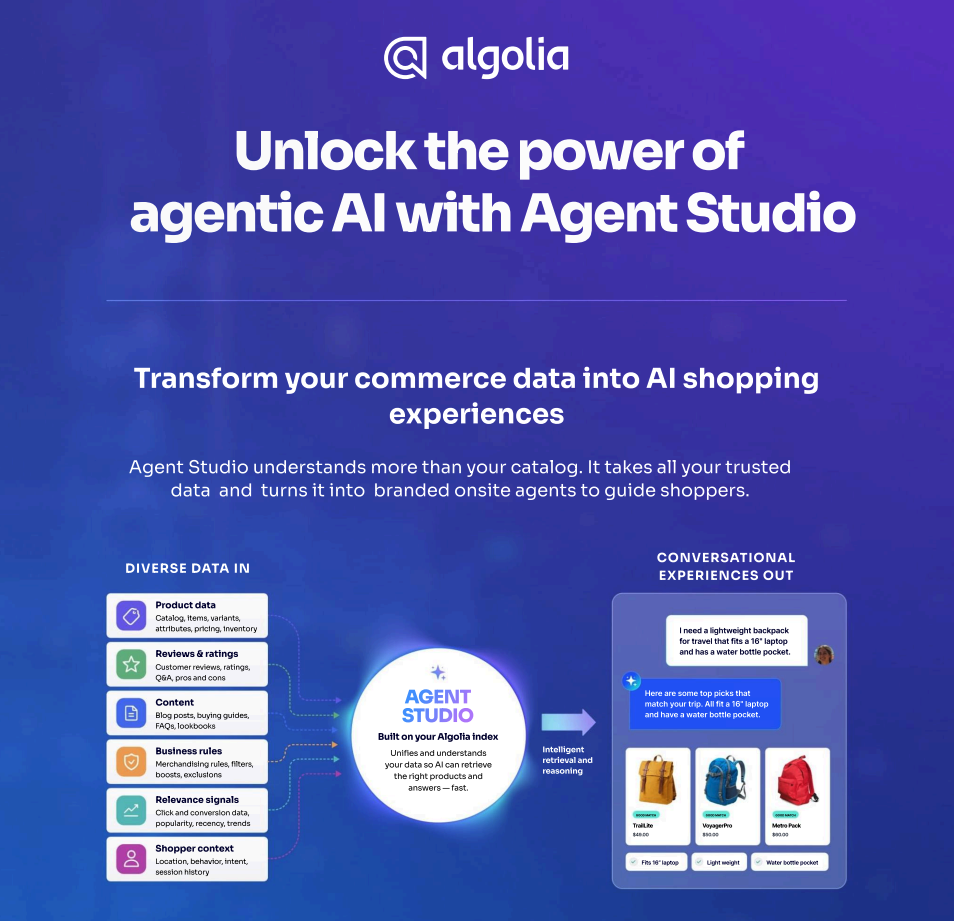
Algolia’s Shopping Assistant acts as a branded digital stylist. It guides discovery, personalizes recommendations, and helps shoppers move from inspiration to desire to purchase swiftly and more efficiently.
The impact shows up in faster paths to checkout, fewer returns, and higher average order value. More importantly, shoppers move through an experience that feels curated rather than transactional.
Search is becoming orchestration
Another important evolution is happening beneath the surface. Search is no longer just retrieval, it’s becoming an orchestration engine.
Traditional search interfaces required users to manually refine their experience through filters, sorting, and repeated queries. This often created unnecessary friction and cognitive load.
Agentic systems reduce that burden by continuously optimizing in the background. They combine retrieval, ranking, personalization, and recommendations into a cohesive experience that evolves in real time and over time.
By acting as an orchestration layer, Algolia connects data, intent, and experience into a unified system.
The result is a shopping journey that feels fluid instead of mechanical.
We are all becoming Miranda Priestly

As these systems evolve, the role of the human changes as well. Users are no longer operators of software. They are supervisors of intelligent systems.
Commerce teams already operate across a dense mix of merchandising, campaigns, inventory, and personalization. Agentic AI can take on much of that operational load, giving teams space to focus on outcomes over execution. In practice, that means less time managing tools, more time evaluating results, and greater control over strategy.
Miranda Priestly does not execute every task. She oversees the system and steps in when something does not meet her standards.
That is exactly the role fashion merchandisers are moving toward.
But control still matters
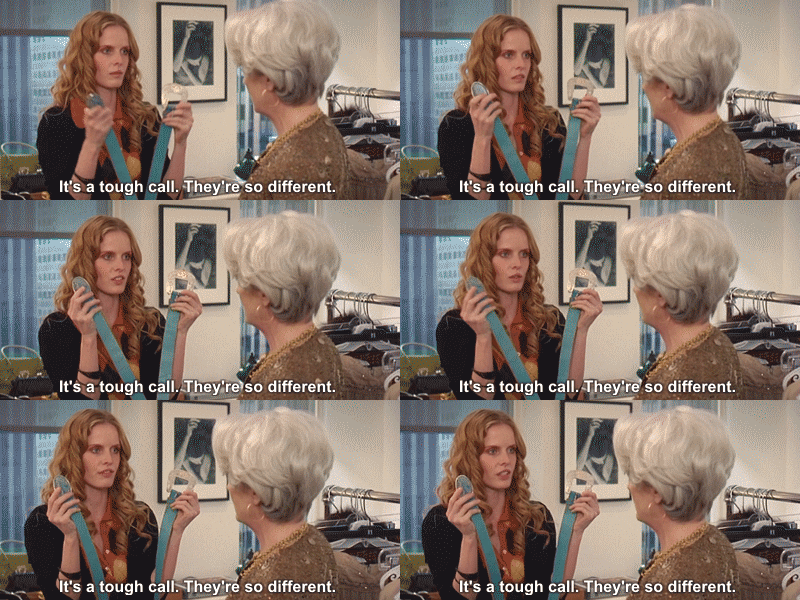
As a metaphor,“The Devil Wears Prada” works well because Miranda can always take control directly, if and when her autonomous-like assistants cannot.
While autonomy increases efficiency, control ensures trust. This is especially important in luxury commerce, where brand integrity and heritage are the heart and soul of their offering.
Algolia orchestrates this balance by keeping key controls accessible when needed, without disrupting the overall flow of automation.
The role of the AI agents must then be to reduce friction and avoid uncertainty.
Luxury expectations are becoming AI expectations
Luxury fashion may be the ideal environment for agentic AI because the expectations already exist.
Luxury shoppers expect personalization, immediacy, elegance, anticipation, and most importantly a sense of individualism. They don’t need to explain themselves. They expect the experience to understand them from the start and adapt as their intent evolves.
That expectation is now becoming the standard for AI.
The goal is no longer to build systems that respond well to prompts. It is to build systems that understand context, act within a role, and continuously deliver outcomes.
In other words, systems that behave less like Andy on her first day at Runway and more like the Andy we see in The Devil Wears Prada 2, someone who already knows what needs to be done.
Or, to put it in Miranda Priestly’s terms:
The expectation is not effort. It is execution.
That’s all.
.gif)












.webp)


.jpg)



%20(2).svg)